
19th Dance Festival, The Music Academy, 7th January 2026
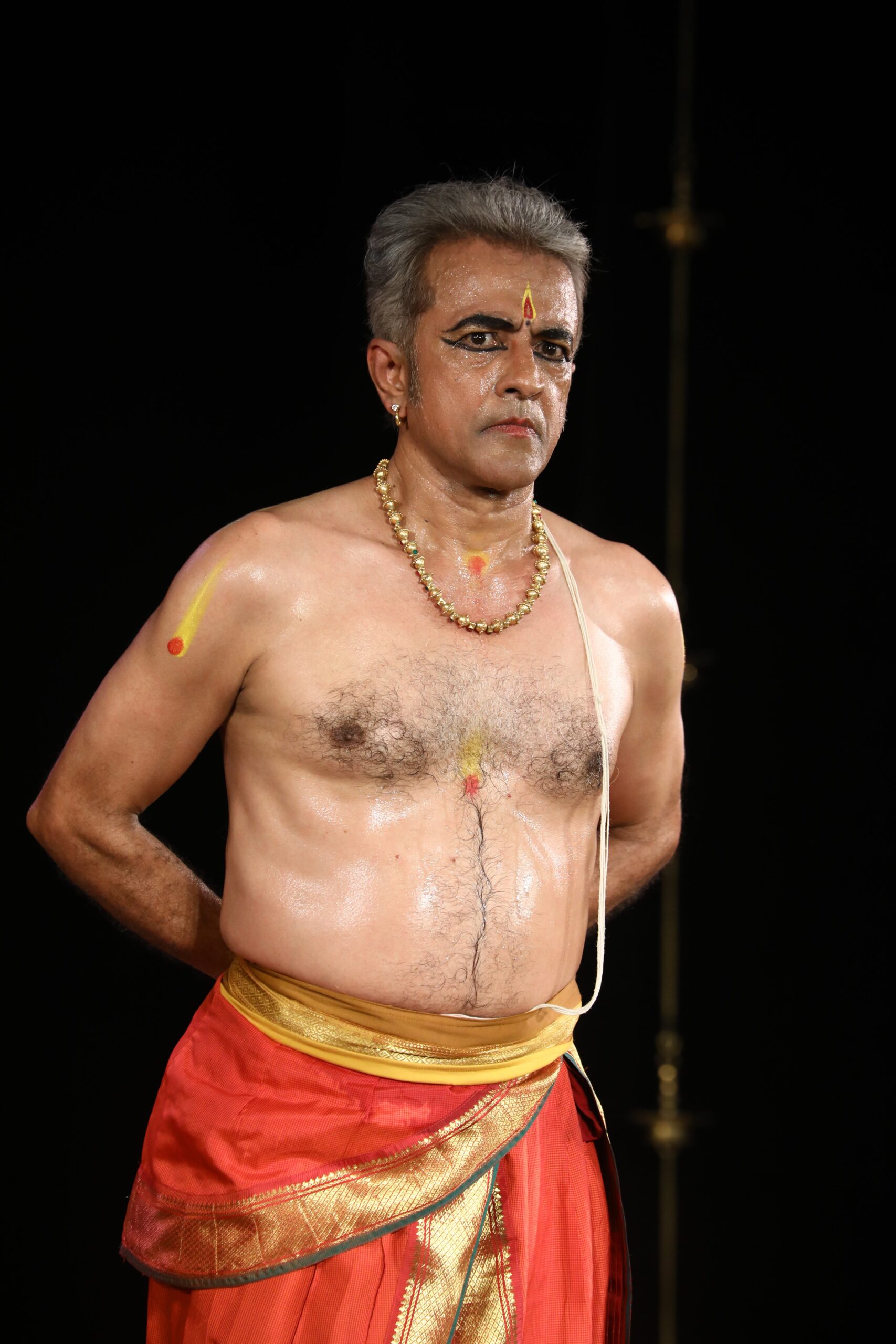
G. Narendra’s latest work, Bhaandavya, is an undertaking few would attempt. Conceived as an ekāhārya lāsyāṅga—a single dancer embodying multiple characters within one costume—the work draws from some of the most formidable figures of the Mahabharata: Suyodhana, Bhanumati, Karna, Dushasana, and Kunti. At its core lies the emotional bonds that shape choice and loyalty.
The opening sequence stages the dialogue between Suyodhana and Bhanumati, his wife. Narendra’s articulation of her fear and foreboding as war approaches, set against Suyodhana’s self-assured valor as a king fully aware of his own strength, brings into sharp relief the fine distinction between arrogance and confidence. Who do we fear, and why? he asks her—an inquiry that resonates beyond the immediate narrative.
The spatial design is carefully thought through: Bhanumati—who inhabits the palace— enters from stage left, while every other character enters from stage right. This detail anchors the dramaturgical logic of the characters within the architecture of the stage itself.
The work deepens considerably in the second act, where the encounter between Karna and Kunti unfolds with restrained poignancy. Her revelation of his birth and plea for allegiance to the Pandavas is met through Narendra’s nuanced use of stance and gesture, revealing first the vulnerability of the mother, before transitioning seamlessly into the prince Karna has become—steadfast in his unwavering allegiance to Suyodhana. Karna’s moral resolve is rendered with restraint and quiet force. His final request—that Kunti acknowledge him as her son only after his death—is shaped with measured understatement.
Subsequent scenes sharpen the ethical tensions: Dushasana’s suspicion contrasts with Suyodhana’s unshaken trust. The final exchange between Karna and Suyodhana affirms Karna’s gratitude and his conscious choice to stand by friendship, even in full awareness of the outcome of the impending war.
Through precise physical articulation, controlled shifts in emotional register, and a commanding sense of stature, Narendra delineates all five characters with striking clarity. The work is further strengthened by the lyrical density of Professor Raghuraman’s Tamil text, translated from Mali’s Malayalam Karna Shapatham, lending the production both gravitas and poetic depth.
Early audio disturbances momentarily unsettled the performance. Singer Venkateswaran Kuppuswamy’s strong, emotionally resonant voice occasionally missed cues—a situation handled with composure by Narendra, who sang on stage when required, and by Mahalakshmi Kameshwaran, whose controlled and assured leadership of the ensemble restored balance. She was ably supported by Ramesh Babu on the mridangam, Kalairasan on the violin, and T. Shashidar on the flute. The musically rich score, conceived by Hariprasad Kaniyal, provided a nuanced and responsive framework for the work. Lighting by Venkatesh was minimal and unobtrusive, allowing the drama to unfold without visual distraction.
Bhaandavya ultimately resides in the precision, control, and moral weight through which its relationships are rendered on stage by Narendra, a consummate artist.
As a witness to Narendra’s artistic evolution since his early twenties—first as Lakshmana in the Ramayana dance dramas at Kalakshetra, then in duets, and now as a soloist—I have observed a performer whose growth has been shaped by discipline, reflection, and sustained inquiry.
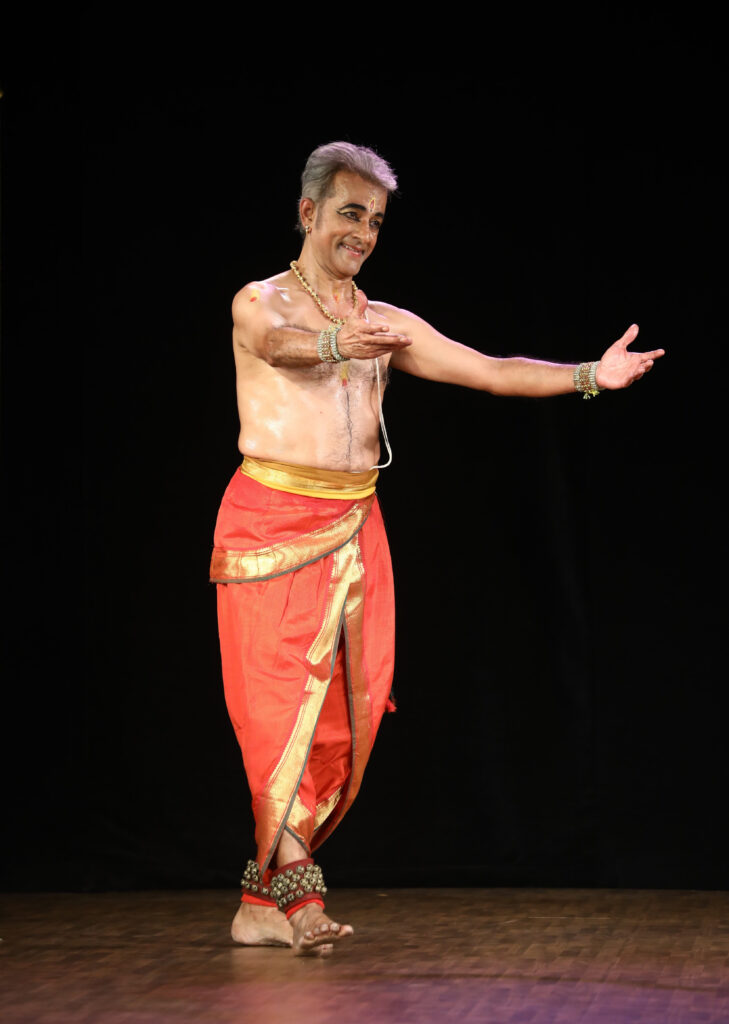
In the conversation that follows, Narendra reflects on the long arc of Bhaandavya—from its early seeds at Kalakshetra to its present articulation.
Q1: What inspired Bhaandavya ?
Narendra:
The seed was planted a long time ago—back in 1991, when I was a student at Kalakshetra and part of the original production of Karna sabadham, performing the role of Suyodhana. Those were intense years. The choreography took months, and as students we were deeply immersed in the process—almost like test subjects, discovering the work as it evolved.
While performing my assigned role, my mind kept wandering. I would watch other characters and think, What if I were doing this role? What would I do differently? That curiosity stayed with me. I left Kalakshetra in 1993, and for many years the thought lay dormant. But Suyodhana stayed with me—because the role was choreographed on me, it left a deep imprint.
Q2: What drew you back specifically to Suyodhana and Karna, and how did you approach their portrayal?
Narendra:
We grow up seeing Suyodhana as a one-dimensional villain. Even today, many people don’t know his actual name is Suyodhana, or that he can be read as a shringara nayaka in many ways. Few people know about Bhanumati, or that he was the only Kshatriya with a single wife.
When I revisited the character through research and reflection, what emerged was not an evil king, but an entitled and empowered one—someone who fought the war in what he believed was a righteous way.
Within the ekāhārya format, I had to ensure that all five characters were clearly distinguishable—from gait to stillness, from stance to temperament. Karna and Suyodhana share a similar stance—they are equals in valor—but their inner orientation differs. Suyodhana carries authority: I chose you as my friend. Karna carries gratitude: You gave me dignity.
Dushasana is more direct; his cruelty is unambiguous. Kunti required the greatest restraint—vulnerability without sentimentality.
Q3: When did Bhandavya finally take shape, and what challenges shaped the work?
Narendra:
Much later, when I sat down with Professor Raghuraman. I told him I wanted to work with Karna sabadham as a source, not recreate it. V. Madhavan Nair (Mali) had written it as a Kathakali play—independent of any single Mahabharata version. That distinction mattered. What I wanted to do was inspired by it, not derived from it.
I began serious work on Bhandavyam about a year ago. It wasn’t planned for The Music Academy—it evolved organically and eventually found its way there.
Musically, the challenges were significant. The work moves through as many as eighteen ragas, and the ensemble came together very late, with limited rehearsal time. At The Music Academy, there are also strict time constraints—you don’t have the freedom to expand or adjust as you might elsewhere. There were moments when I chose silence over music, or had to respond on stage—singing myself, or signaling changes. That kind of responsiveness, that manodharma, becomes part of the performance. Not everything can be fixed in advance.
At its core, Bhandavya is about friendship—not as sentiment, but as ethical commitment. That is why I named it Bhaandavya, bonding, rather than Sabadham, an oath.The vow is implicit: Karna’s decision to stand by Suyodhana, fully aware of the consequences. That question—what do we stand by, and why—is what finally found form in this work.