
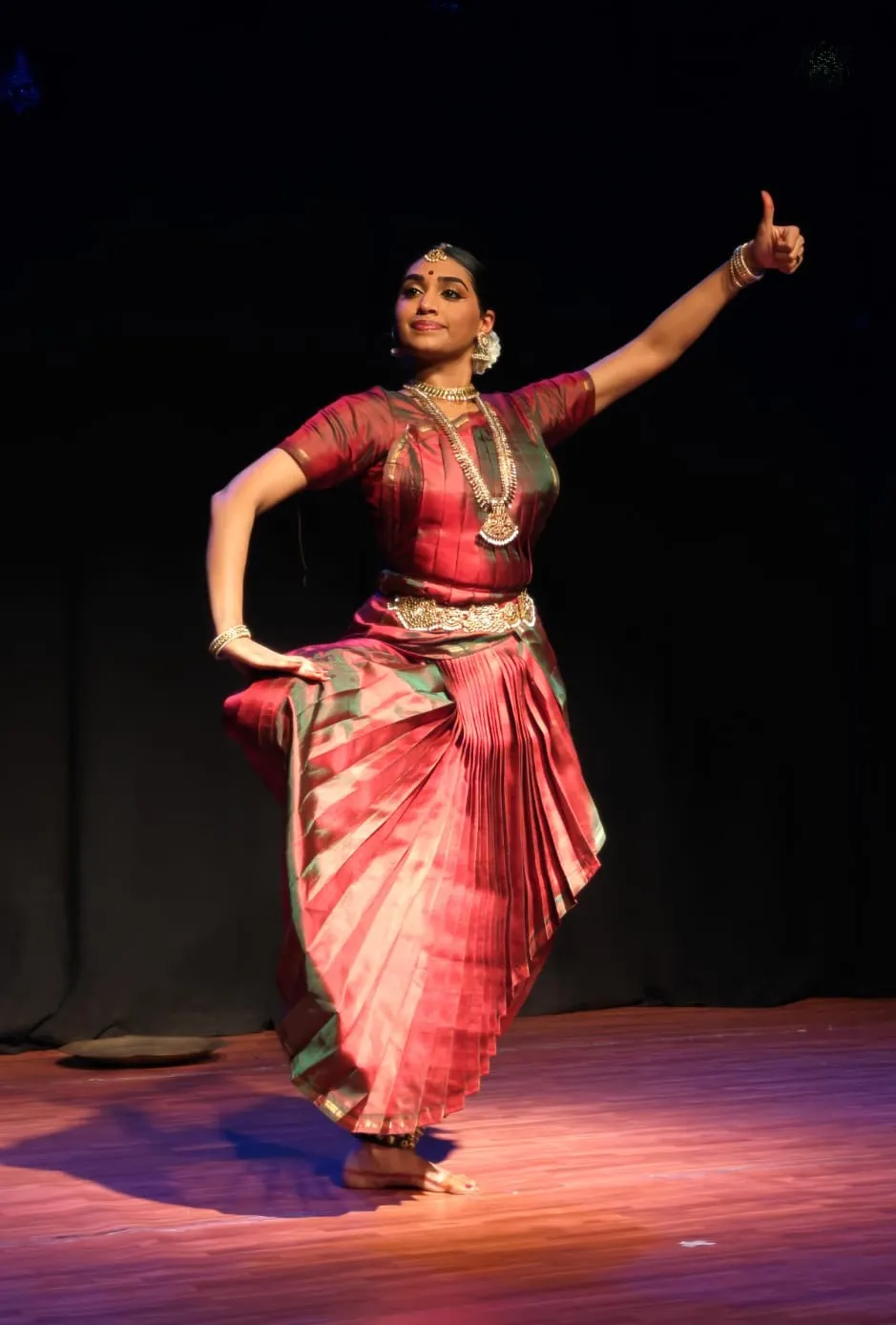
Jan 29th at MEDAI: The Stage, Chennai
A warm yellow spotlight illuminated Kuchipudi dancer Pragnya Thamire in a deep forward bend, her body folded in supplication, offering what seemed to be herself along with flowers. There was something profoundly devotional in the way she held the muscular tension of her spine—strength born of discipline. This opening image set the tone for a recital grounded in control and reverence for the form.
She rose from this position to a śloka—Ya Kundendu—on Saraswati, followed by Muthuswami Dikshitar’s Sri Sarasvati Namostute, a choreography by Guru Sri. Jai Kishore Mosalikanti. Gliding across the stage with ease, Pragnya sustained clean lines and clearly articulated mudra-s. Her long, graceful limbs shaped symbolic and metaphorical narratives with clarity, embodying what yogic philosophy describes as the quality of practice—sthira and sukha, steadiness and comfort.
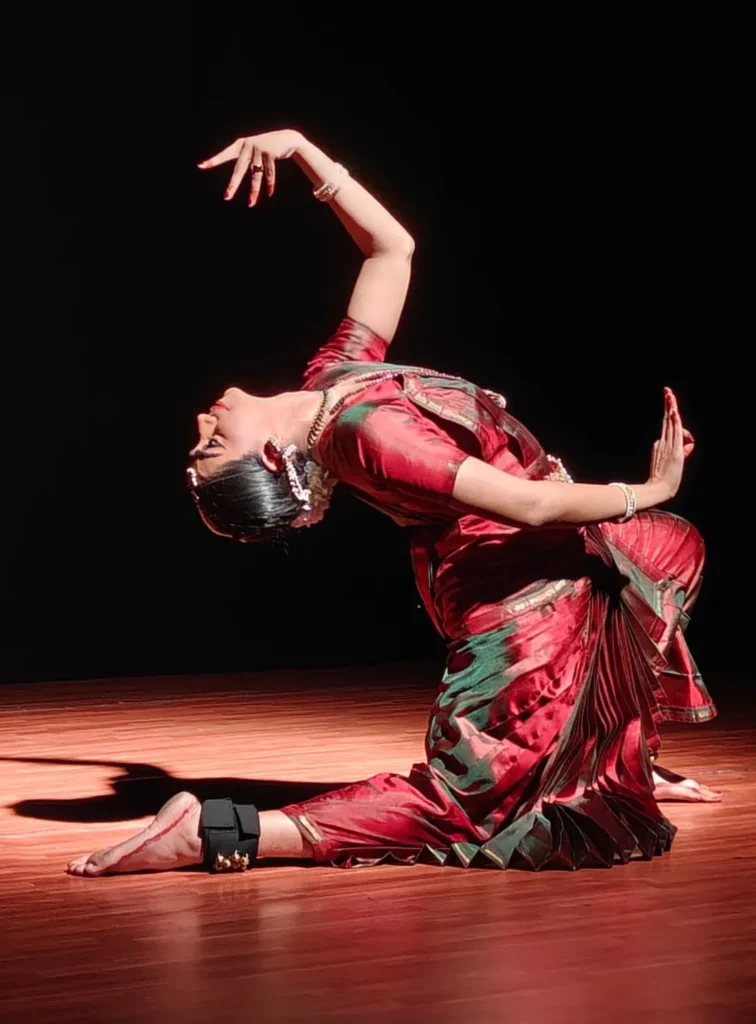
In her second piece, Balamurali Krishna’s Omkara Karini, she unfolded—by contrast with the first piece—from a forward bend into a deep backbend, her spine curving and opening to the syllables of Om, offering a visual rendering of the sacred symbol itself. With her left hand held aloft in alapadma and the lower hand in haṃsasya, she portrayed the Goddess as the primordial sound, Omkara. Drawing from the Devi Mahatmya, the narrative describes the demon reduced to ashes by the Goddess’s resonant utterance of Huṃkara. While Pragnya’s spatial use of the stage clearly bifurcated the demonic and the divine, the distinction in facial expression remained less precise—the smirk and quiet laugh of ridicule appeared similar in both portrayals. Here, sharper differentiation in abhinaya would have strengthened the dramatic contrast the story demands.
Jayadeva’s ashtapadi Sa Virahey Tava Dina, choreographed by her guru Anuradha Nehru, formed the emotional core of the recital. This piece would have benefited from a slower, more deliberate pacing, allowing deeper engagement with the layered emotions of Radha, the sakhi, and Krishna. Viraha in this ashtapadi calls for a gradual emotional build-up, from the sakhi speaking of Radha’s plight to her narration of Radha’s laments, laughter, dejection, and tears in her longing for Krishna. A more nuanced exploration of the lyrics and emotional transitions could have enriched the internal landscape of the piece.
The concluding item, Aloke Bala Krishna from Krishna Lila Tarangiṇi, was a refreshing and assured finale, even though it is traditionally placed as a central piece. Pragnya presented it with characteristic grace, rhythmic precision, and a clear sense of joy, closing the recital on an affirmative note.
Lighting by Harsha remained consistently supportive throughout the evening, drawing attention to her movements.
What remained most compelling throughout the evening was Pragnya Thamire’s confidence and unmistakable respect for the form. She dances from the heart, and the feeling carries through. It is heartening to watch young performers from the diaspora engage deeply with our dance traditions—creating worlds shaped by word, meaning, and emotion, inspired by mythology and the human condition, and sustained by an artistic journey of rigorous training and self-discovery.