
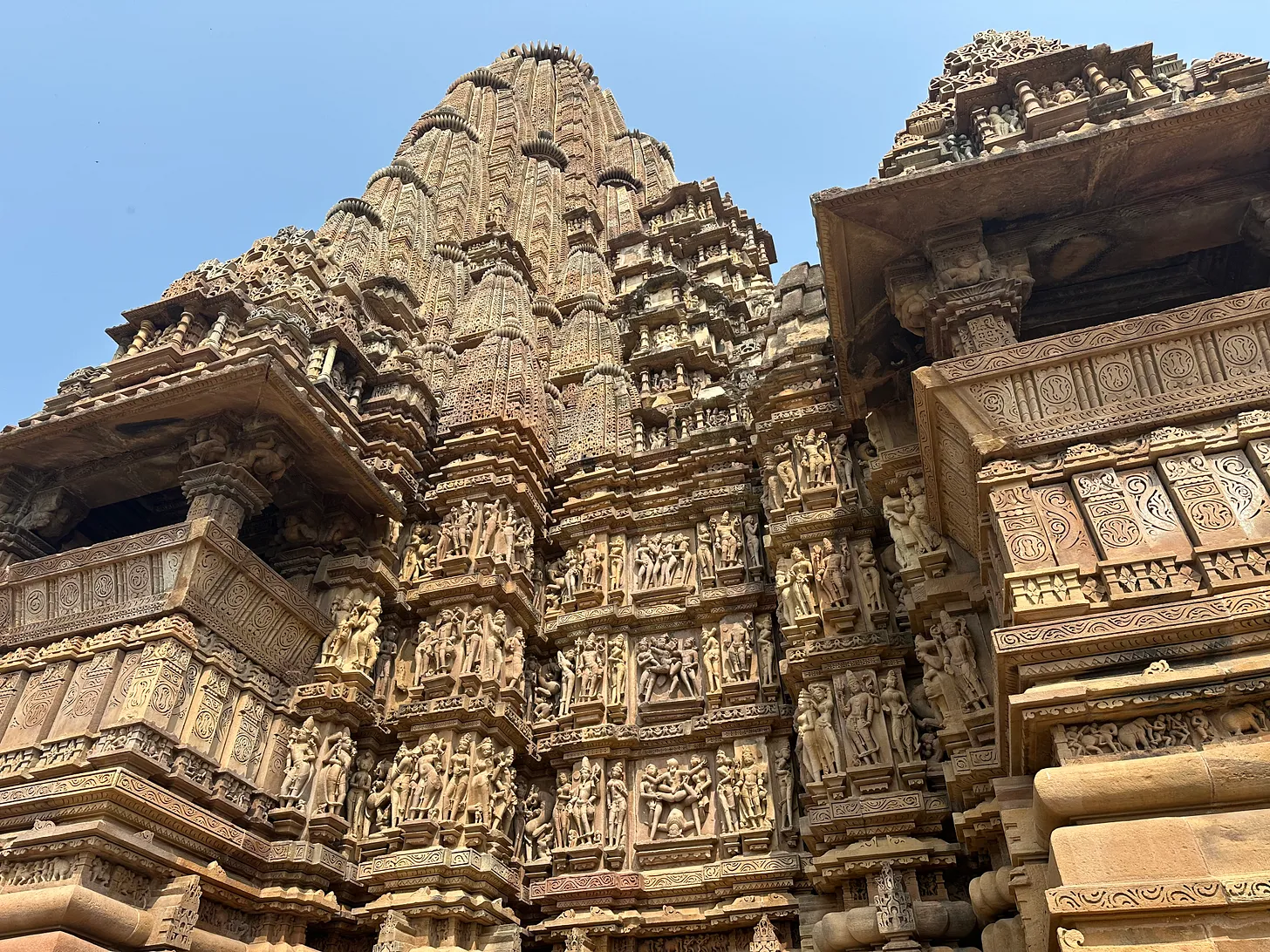
By the third day, the Western Group of temples felts overwhelming as it began to reveal a deeply philosophical motif in its structure.
Our guide Mr.Rajendra Verma spoke of sandstone — the warm, honey-toned stone that gives Khajuraho its luminous quality at dusk. It was quarried locally, he told us, from Panna, known for diamond mining. The sandstone that was removed in search of diamonds was used to build the temples; and the diamonds, legend has it, helped pay the artisans who shaped them. Whether apocryphal or factual, the interplay between stone rising from the earth and diamonds funding labor while devotion shaped through both material and wealth.
Standing again before the Kandariya Mahadeva Temple, I was drawn not just to its height but to its alignment. The temple rises like a spine — central, ascending, steady. The clustered śikhara-s gather upward in rhythmic gradation, vertebra-like. Along the exterior walls, vertical projections intersect with horizontal sculptural bands, creating a sense of contained ascent.
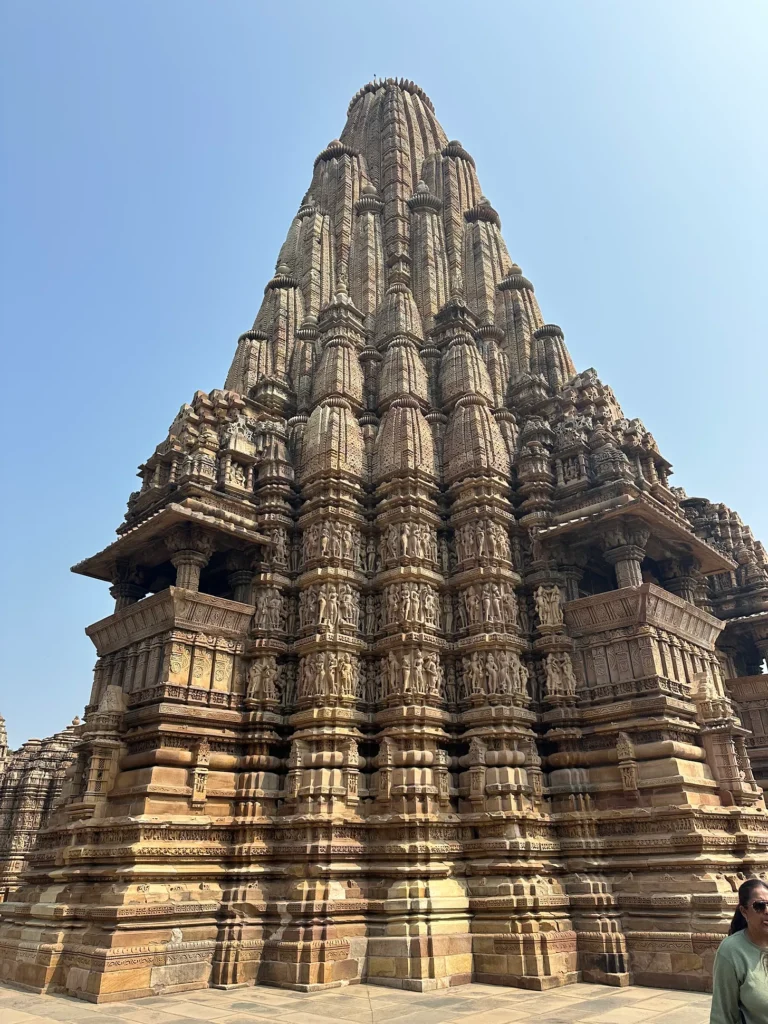
It is difficult not to see in this verticality an echo of yogic anatomy — iḍā and piṅgalā flanking the central suṣumṇā, energies rising in alignment. Whether intentional or not, the motifs suggest upward movement of energy.
In the evening, the performances opened with a Manipuri recital by Thokchom Ibemubi Devi, who began with a Gaudiya Vaishnavite prayer, Ajnana-timirandhasya, prostrating in devotion before placing down a lit lamp. The gesture was unhurried, inward. The invocation established the devotional tone before movement began.
She then set the context for the Gīta Govinda with its opening verse, Meghair meduram ambaraṁ. To the gentle resonance of the pung, four gopīs and one Krishna entered. The compositions — Chandana Charchita, Māmiyaṁ, and Yāhi Mādhava — unfolded with the characteristic grace of Manipuri: rounded torsos, soft footwork, restrained abhinaya. The evening concluded with a dramatic ārati — the waving of a white fan before the image of Rādhā-Kṛṣṇa — bringing devotion full circle.
The next presentation brought nine disciples of Guru Shri Durga Charan Ranbir to the stage. Using the central staircase as an axis, they moved in synchrony for Āditya Archana, offering homage to Surya. Beginning with movements resembling sun salutations — the bending and rising echoing the temple’s vertical spine — they transitioned into Pallavi and Bāl Gopāṣṭaka, depicting the playful deeds of young Krishna.
The choreography was expansive and detailed. However, the presentation extended beyond the allotted forty minutes. In festivals where multiple classical forms share a two-hour window, timing becomes part of artistic discipline. When one segment exceeds its time frame, the continuity of the evening is disrupted. By the time the next performance began, several audience members had already begun to leave.
The Sattriya presentation by Sattriya Kendra restored energy to the stage. A dynamic blend of male and female dancers moved in synchrony through Dāyan Bāyan Ki, incorporating chari-s and bhramari-s. The opening, reminiscent of the pūrvaraṅga described in the Nāṭyaśāstra, featured five male dancers — three playing drums while dancing, two striking large bortaal-s — creating a powerful rhythmic foundation.
This was followed by Krishna Vandana, depicting Devaki and Nanda’s welcome of Krishna and prayers for his divine compassion, including the lifting of Govardhana to protect his devotees. The staging, at one point adorned with lotus imagery, carried devotional warmth. The evening concluded with Daśāvatāra, tracing the incarnations of Vishnu with synchronized clarity.
By the close of Day Three, what remained was the depth, scale and dramatic differences in each of the classical styles, informed by social and cultural mile that shapes the art form. The comparison between the dance, dancers and temple was evident. The temples rise like a spine, disciplined and aligned. The dancers, disciplined by their respective forms in their own ways, rise and bow within that frame.
Khajuraho does overwhelm by scale but the many ways it speaks to its visitors, through time