
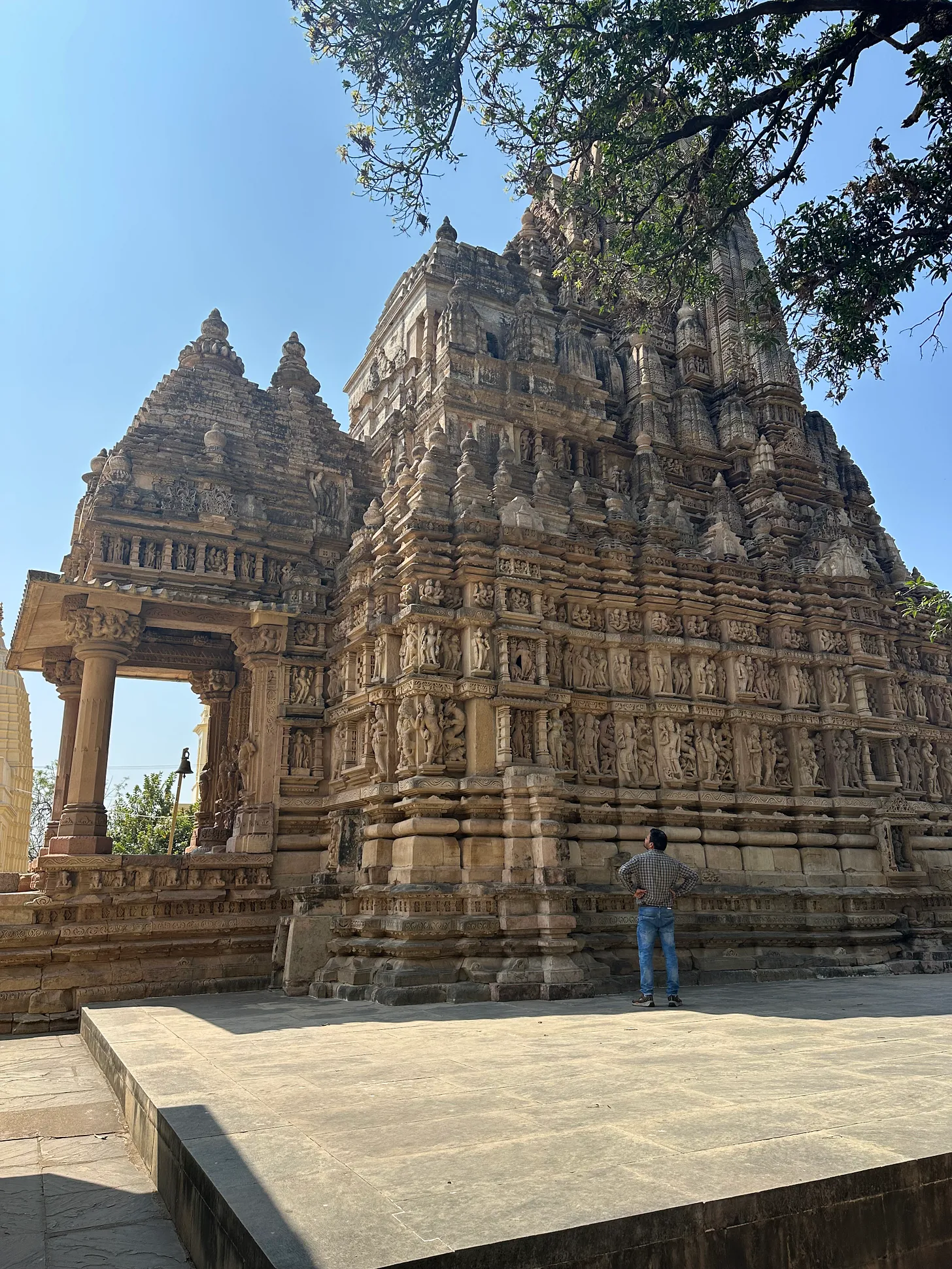
The fifth day at Khajuraho began under a bright morning sky. After breakfast, we set out toward the Eastern group of temples with Salman, our driver, who cheerfully warned us about what he called the “jumping road”—a bumpy stretch that would make the car seem to dance its way across the countryside.
We had deliberately chosen not to read or research the temples beforehand, preferring instead to encounter them as they revealed themselves. There is a particular freshness in approaching a historic site without preconceptions, allowing first impressions to shape one’s understanding.
What struck me immediately upon arrival was the coexistence of old and new structures, and with it a striking contrast in workmanship. The ancient temples display breathtaking precision: every inch of stone alive with intricate detailing, layered iconography, and sculptural rhythm. By contrast, the more recently constructed temples nearby appear far simpler in execution.
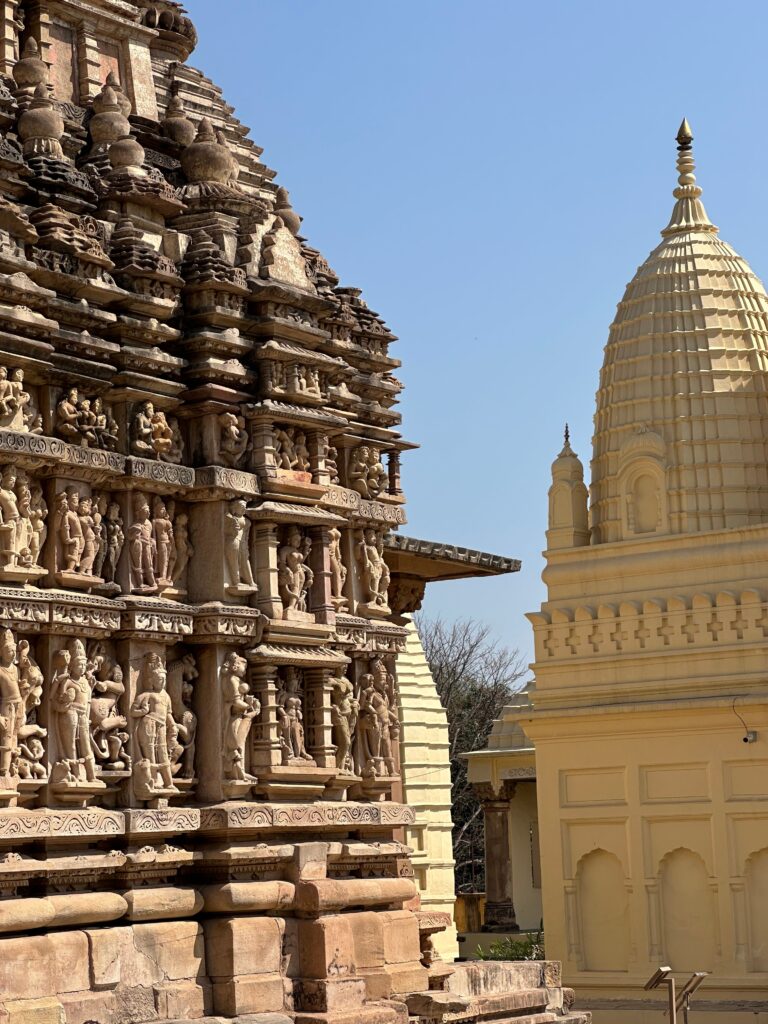
It raises an intriguing question: why are we unable today to reproduce the same extraordinary intricacy achieved by these medieval artisans? The answer perhaps lies not only in technique, but also in the time, devotion, and collective imagination that once shaped sacred architecture.
The Jain temples offered a markedly different experience from the Western complex. If the earlier temples celebrated the vitality of life through their sculptural exuberance, these spaces invited a quieter, more contemplative engagement.
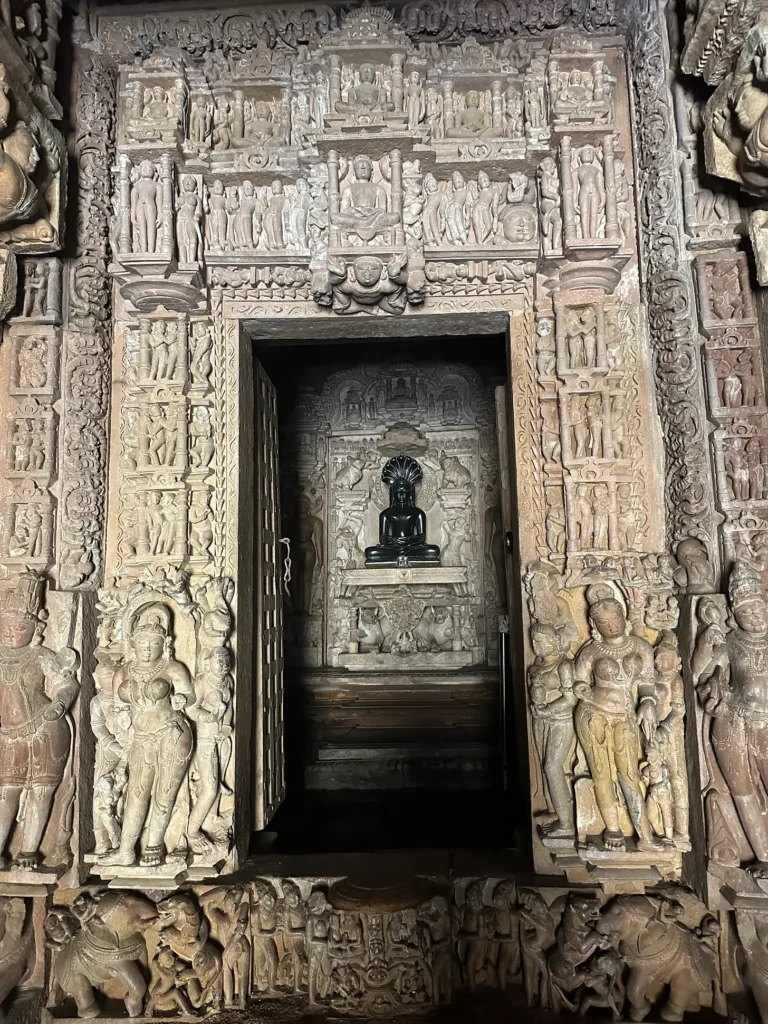
The Ādinātha Temple stands toward the front of the complex, while the Pārśvanātha Temple lies further behind. The sculptural program here is noticeably less erotic and more mythological in character, with figures such as Sūrya and Kubera and Jain Tirthankaras appearing among the carvings. Our guide Rajendra Verma informed us that these temples are active places of worship. Historical accounts suggest that the temple was commissioned by a wealthy merchant, with the permission of the Chandela king—an important reminder that sacred patronage in medieval India extended beyond royalty.
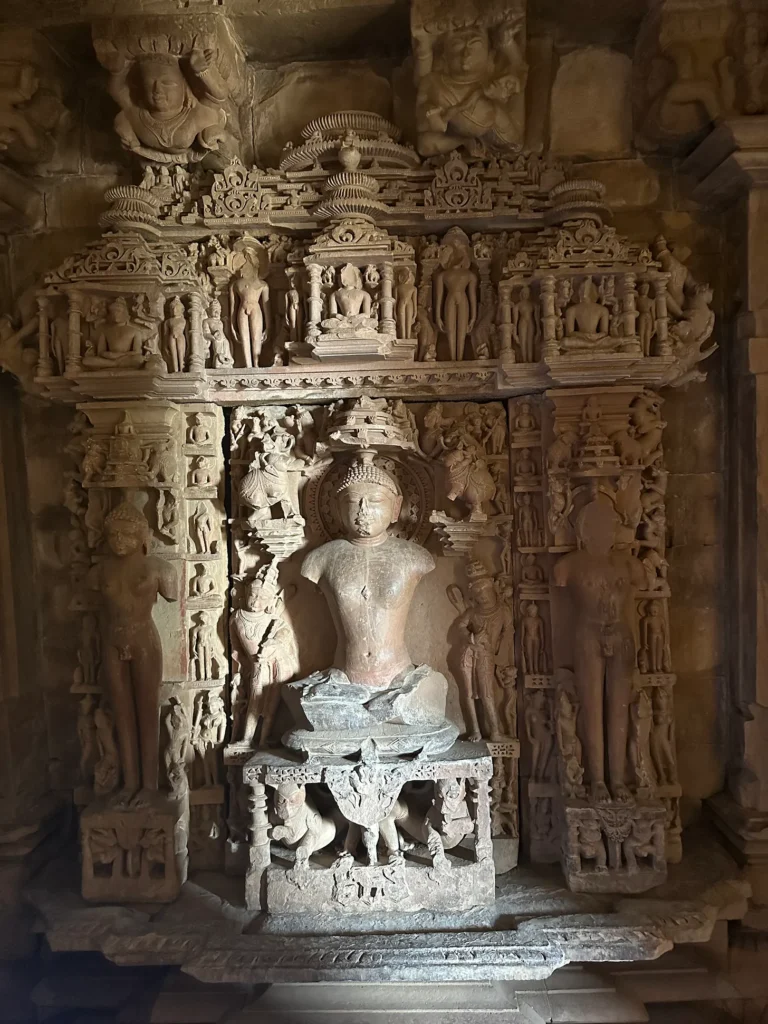
The site today is beautifully maintained by the Archaeological Survey of India, and nearby stands an old well—an evocative reminder that temples were not merely places of worship but part of a living landscape of water, community, and daily life.
In the stillness of these Jain shrines, Khajuraho revealed yet another dimension of itself—one of meditation and inward reflection. Their presence speaks to a time when Jainism and Hinduism coexisted here, each finding expression within the same sacred landscape.
The evening performance back at the Western group of temples began with Shinjini Kulkarni, Kathak dancer and granddaughter of Pandit Birju Maharaj. She opened with a vibrant invocation to Lord Ganesha, Gajananam Bhutaganaadi Sevitam, before moving into energetic passages set to tāl dhamār, followed by a traditional bandish.
Her solo abhinaya, Bihari ko apne bas kar pāo, was particularly engaging. In this piece, different devotees attempt to draw the attention of Lord Krishna in their own ways—each calling out to him through their devotion—while Krishna, playful and compassionate, responds to each in turn. Kulkarni rendered these shifting emotional shades with sensitivity and charm, bringing the narrative alive.
The next presentation was Odissi by Dr. Ileana Citaristi and her group, which began with Adi Shankaracharya’s Ganga Pranaam. While the piece held promise in concept, the performance unfortunately lacked the clarity and structural precision that are hallmarks of the Odissi tradition. The grounded articulation of footwork, the sculptural definition of the form, and the cohesion within the group choreography did not fully come through.
Driving back that evening, I was struck by how the day had unfolded in two distinct registers. The Jain temples of the Eastern complex offered a quieter vision of Khajuraho—one sustained by merchant devotion and the contemplative ethos of Jain practice. Their presence revealed the site as a shared sacred landscape where different traditions once coexisted with remarkable ease.
The evening’s performances, unfolding against the monumental Western temples, seemed to echo this layered inheritance in their own way—each artist negotiating tradition, lineage, and contemporary interpretation. Between the stillness of the shrines and the energy of dancers on stage, Khajuraho seemed to remind us of the inherent beauty within inherited traditions—whether expressed in stone or through the living body of dance.