December 13/14 at The Dance Complex, Boston, 2025
As I entered The Dance Complex in Boston, I was greeted by a friendly attendant to whom I gave my name. Moments later, I heard the sound of fire crackling and instinctively asked her about it. She paused, glanced around, and smiled, “Oh, it’s from the TV.” Sure enough, a screen nearby glowed with the image of burning firewood.
That sense of warmth on a cold Boston evening quietly set the tone for what was to come.
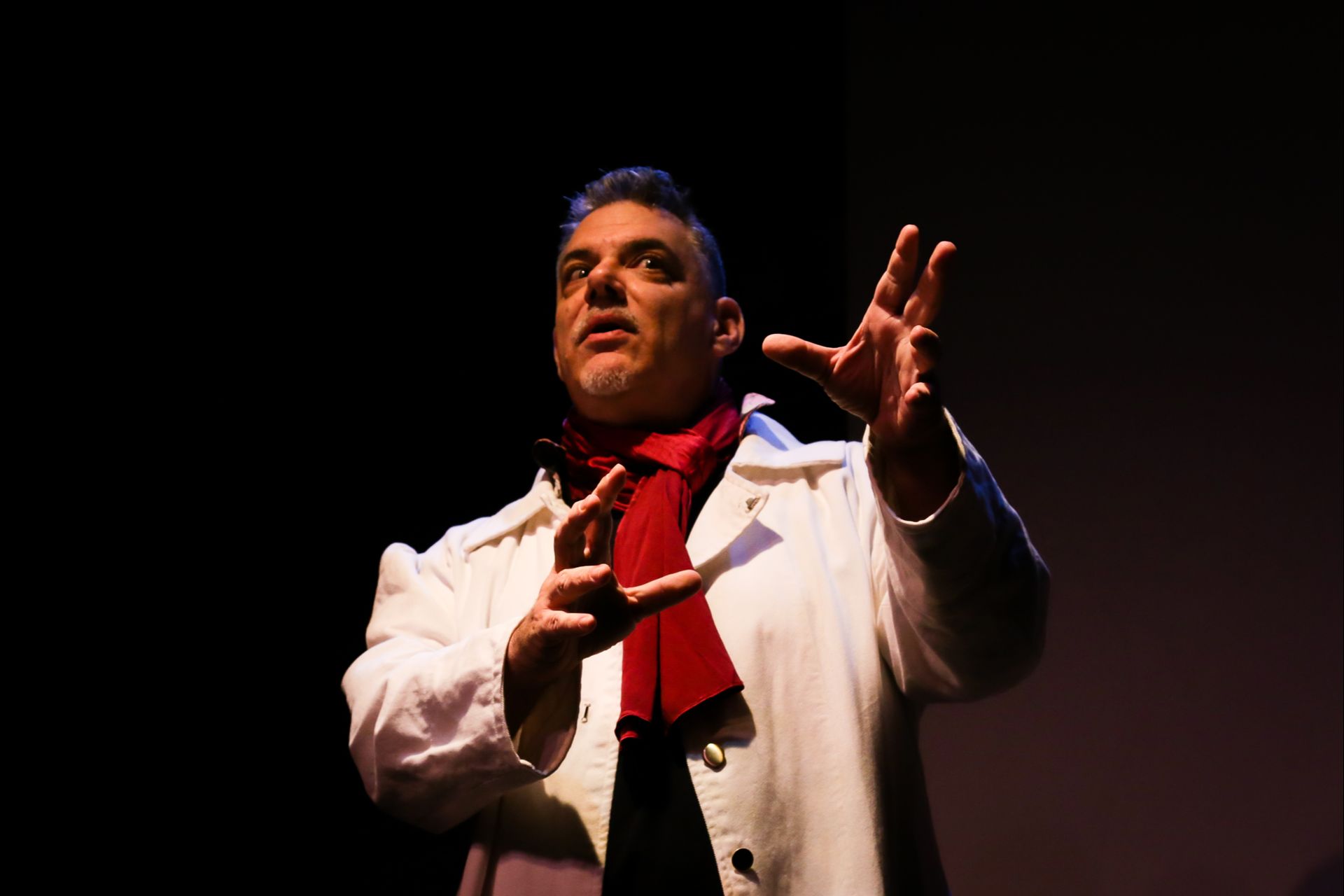
Arranged as a personal invitation rather than a formal performance, Funny Uncle Cabaret unfolded with every audience member welcomed and seated by Peter DiMuro himself—an intimate gesture that immediately dissolved the usual boundaries between host, performer, and spectator.
The evening commenced with songs by Robert McFletcher Jones & the Mason Chorus Ambassadors. Nothing like the energy of young children to set our feet tapping. They were led by the dynamic conductorship of Robert McFletcher Jones, who also delighted the audience with a solo—his voice rich, resonant, and filled with emotion. From there, a series of short episodes emerged—odd, queer, and gay stories shared through song, dance, and spoken narrative. Peter DiMuro’s flamboyant charisma and easygoing monologue, recounting his experience of being an uncle—much like Drosselmeyer in The Nutcracker—held us captive. Its brevity, however, left one wishing for more.
This spirit of intimacy and participation carried seamlessly into the musical and movement-driven segments of the evening. Through his effortlessly fluid piano playing, musical director Brian Patton shaped the emotional landscape of the cabaret, guiding the evening’s mood and flow while drawing and encouraging the audience to sing along. Yosi Karahashi’s flamenco was vibrant and energetic, offering a striking counterpoint to the introspective movements of Public Displays of Motion’s core collaborators—Anne Brown Allen, Irene Lutts, Lindsay Caddle LaPointe, Jimena Bermejo. and Ann Fonte—whose work grounded the evening in a shared sense of intimacy and wit.
At the end of the evening, I couldn’t help but reminisce about how people across generations sang and danced together. I loved how everyone was invited to be part of this radically inclusive space. Many questions came to mind as I reflected on this never-before experience.
What follows are Peter’s responses to those questions.
Q1. As someone coming from a South Asian performance background, cabaret feels like a distinct idiom. What defines cabaret for you, and what draws you to this form as a container for storytelling?
Like “dance,” cabaret resists a single definition. There is a recognizable version—a lone singer at a microphone, with accompaniment, perhaps telling a story to set up a song or a series of songs—but there are also countless hybrids: multiple performers, the singer as host, spoken text interwoven with music, movement, and humor.
What draws me to cabaret as a storyteller is the permission it offers to work in fragments. I can tell several short stories—often connected loosely by a theme—without needing to construct a grand, overarching narrative. The modern dance concerts I grew up watching typically followed a few established models: three to five works in an evening, sometimes stretching beyond two hours, or a single evening-length piece lasting anywhere from forty-five to ninety minutes. Cabaret feels refreshingly different from that expectation.
When I began singing about ten years ago, I spent time at open-mic nights—spaces that were open, generous, and deeply supportive. What struck me there felt familiar. Much like my experience engaging community members through dance, these evenings brought together a wide range of styles, voices, and expressions that were almost always authentically of the person performing.
For me, cabaret became a term—a container—that allows many small things to coexist without apology. It doesn’t demand a manufactured cohesion beyond what juxtaposition naturally creates, though it can also support a carefully shaped narrative arc if one chooses. Above all, it gives me permission and freedom simply to make—to get something out of my system, honestly and directly.
Q2. What drew you to the parallel between your reimagining of The Nutcracker through LGBTQ+ lives and chosen families, and your own experience of being an uncle? Why did it feel important to place these narratives side by side?
When the first ideas for this piece came to me, I was in my late twenties, in the mid-1980s. While it wasn’t unheard of, it was still rare for gay men to adopt, foster, or—through an expensive route—have a surrogate. Like many who find themselves in “othered” categories, this put me in a mindset of going through all these emotions as Drosselmeyer, the uncle, with his favorite niece, making all this magic happen.
Filling up that stage night after night—performing for three or four thousand people—was exhilarating and exhausting. I would get offstage and weep in the wings as Clara went off to the Land of the Sweets.
As a gay man, this blended my performance, the story, and my personal life. I began writing these stories in earnest just before—and as—my sister talked about adopting, which created another distanced relationship to a child who was far away and not yet legally my sister’s.
The context of the times—just after the height of the AIDS crisis, and the limited freedom we had as gay people—surely contributed to this.
In all my work, I try to find portals where anyone, regardless of who they are, can find an emotional connection. These strands of story felt necessary to place side by side, allowing the work to have a multilayered impact.
Q3. Tell us about Public Displays of Motion and your collaboration with artists Ann Brown Allen, Irene Lutts, Lindsay Caddle LaPointe, Ann Fonte, and Jimena Bermejo. How do these long-standing creative relationships shape the work you make together?
I’m fairly thin-skinned, and making dance is deeply vulnerable for me. I really need the people in the room to be supportive. All of these dancers are extraordinary human beings who just happen to have movement as a language. They’ve indulged me—my endless questions, my tweaking, my rearranging of their material.
In the early days, I made most of the movement—maybe 80 percent of it. Now, it’s almost the reverse. Sometimes I make none of the movement at all. The material is generated through their improvisations, and then we shape and set that material together. They are very much part of the creative process.
I also take into account what I know about them as human beings—their family relationships, their love lives, their strengths and weaknesses. I try to build dances that respond to the ecology of who these people are, especially as it relates to the subject of the work we’re making.
I don’t rely heavily on long bouts of unison movement because I don’t think the world really works that way. I tend toward simplicity, and—even to the chagrin of some—I often avoid spectacle in movement. I feel that the pyrotechnics and gymnastic virtuosity of certain forms need to be earned within the arc of a dance’s composition.
I never want the human being to disappear behind the movement. I don’t want an audience member to stop seeing Ann, or Jimena, or Irene because we’re relying on a trick or a flashy gesture. The person has to remain visible.
It’s also rare for us to receive commissions with healthy budgets. When we worked with the Greenway or the Gardner Museum, those residencies actually paid for dancers’ time and included a commission fee for me, which I then reinvested in the company. Smaller grants and ticket income—say, from Funny Uncle Cabaret—don’t even cover a third of the costs.
So while I’d love to say we’re always creating entirely new work, I often rely on dancers’ muscle memory—bringing back older material or borrowing from previous works for a cabaret number, for instance. That flexibility is not just practical; it’s essential.
Q4. How do you see Funny Uncle Cabaret evolving—does it remain deliberately open-ended, or do you imagine it changing shape with time and place?
From the very beginning—when it existed only as a monologue without movement—to what it is now, a full-fledged 90-minute work with nine dancers and a chorus of roughly eighteen performers, including both professional and community dancers, Funny Uncle Cabaret has always been morphable.
As I mentioned on one of the nights during this recent run, I may let the piece rest for a year or two and see what comes next for it. As I tried to convey in this year’s performance, I’m not the same person I was thirty years ago, and the world is certainly not the same either.
Our ideas of chosen family have evolved. The permissions we once assumed—what it means to belong, to care, to claim space—have shifted, and in some cases have been threatened in the current political climate. Because of this, I think the work will always retain the ability to respond to the present moment. Its openness is not accidental; it is built into the work.
Q5. Do you think the histories of queer community-building and chosen families influence the openness, humor, and participation we see in spaces like Funny Uncle Cabaret?
Early on, I felt it was important to show not the victim but the victor aspect of being gay. During the AIDS crisis, I made work that focused on expression and communication—some of it very sad and deeply affecting—but at the same time, I also created a series of workshops called Coming Out for Straight People.
The idea was to shine a positive light on a skill that many gay people develop: coming out. Revealing what’s in your closet. I felt that this could help others come out about things not related to sexuality—such as admitting to your parents a career choice they might not approve of, or who you might marry outside of race or expectation.
I want to make a distinction here—very deliberately—between gay and queer. I think gay people, across generations, have used humor to disarm and offset difficult situations for much of their lives. This includes men and women, people my age, younger generations, and certainly older ones. Humor has been a survival strategy.
The drag community, which is a subset of our larger community, has taught us how to use spectacle on our own terms—reclaiming what might otherwise be used as something derogatory—and to do so with flair and wit.
I differentiate between gay and queer because, over time, the younger generation has embraced the term queer, which I see as more politicized than gay. I have no problem with that whatsoever. I think it’s essential to take a political stand for what you believe in.
Ultimately, when we look at conversations around race, access, agency, bias, and other deeply rooted social issues, I believe they can only be addressed through a combination of hard conversations, deep dialogue, and a culture of lightness. Humor plays a crucial role here—it helps us recognize what we may be holding onto that prevents us from moving forward or reaching reconciliation.
Credits
Concept, Text & Direction: Peter DiMuro
Musical Director: Brian Patton
Choreography created collaboratively with performers
Core collaborators: Public Displays of Motion
“My Ship” choreography: Kara Fili & Peter DiMuro
Scenic Design: Jayne Murphy
Lighting Design/Operator: Jason Ries
Stage & Production Management; Sound & Images: Olivia Reinbach
Video & Image Editing: Lindsay LaPointe / Linden Tree Productions