
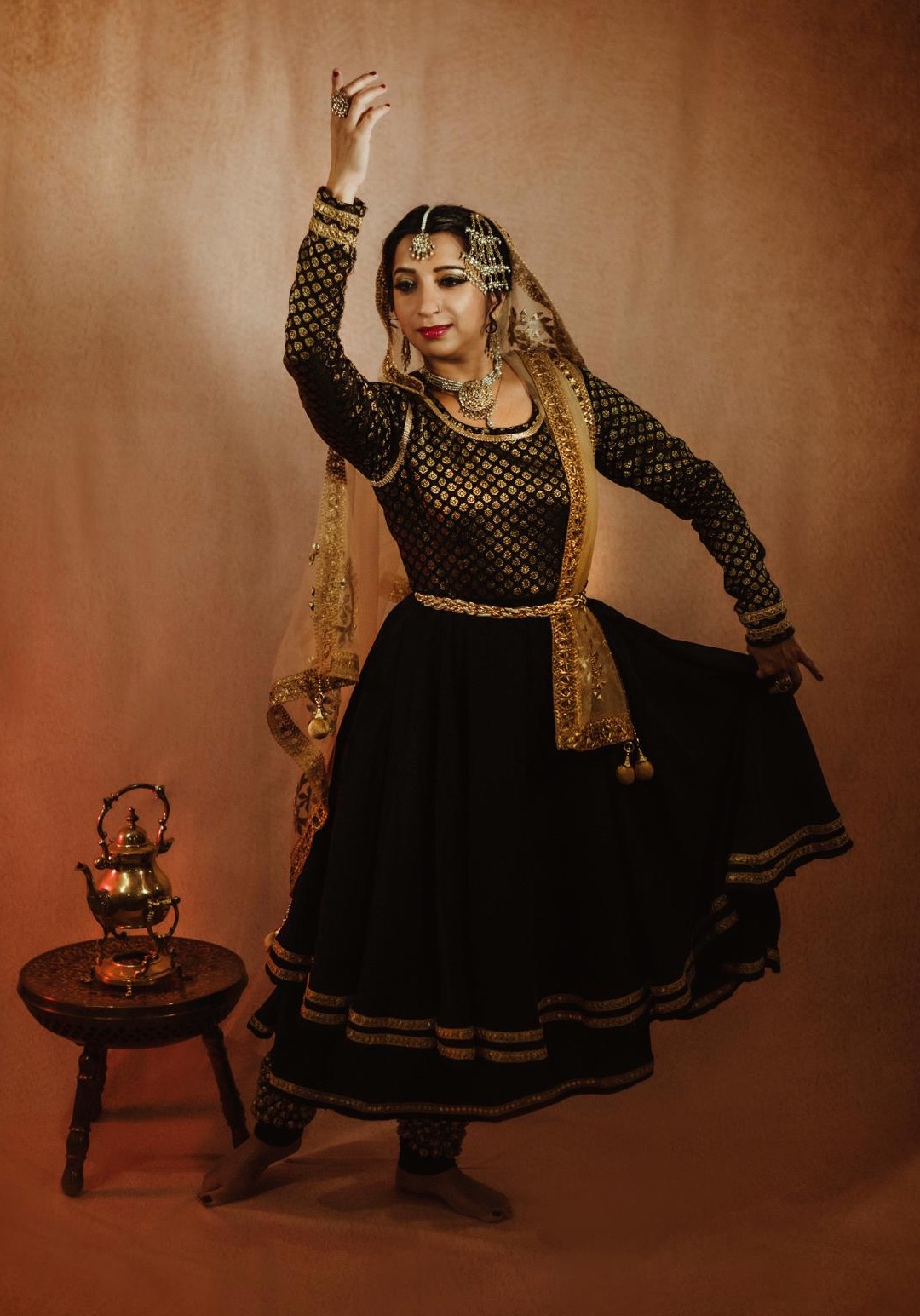
Presented by Global Indian Artist in partnership with Kanakavalli, celebrating tradition, lineage, and rootedness. This feature is written by one of the disciples of Nrityavali Gurukul ( Pallavi kathak LLC) reflecting on the work and legacy of their Guru in the United States.
Introduction
In a world moving at lightning speed, where attention is fleeting, conversations shrink into notifications, and the noise of modern life grows louder: it can be said that deep cultural learning has become increasingly rare. In the multicultural rhythms of New York and New Jersey, where identities overlap and diaspora stories evolve daily, many children quietly wonder: Where do I belong? Who am I? What will guide me as life accelerates around me?
For more than two decades, Guru Pallavi Degwekar has been answering those questions through the pure, meditative discipline of Kathak, one of India’s eight major classical dance forms. Rooted in the ancient practice of storytelling, Kathak is a sacred art form of rhythm, expression, and devotion. Traditionally performed by Kathakars, storytellers who carried history and philosophy through movement, the form weaves together intricate footwork (tatkaar), rhythmic cycles (taal), expressive storytelling (abhinaya), and musical improvisation. In today’s diaspora, Kathak holds an even deeper meaning, it becomes a bridge between generations, a way for young people to inherit memory, identity, and cultural responsibility through the body. As said by famous cultural anthropologist William Haviland, “Culture is learned rather than biologically inherited” (Haviland 2016). Within this statement, it is fair to say that Guru Pallavi Degwekar is not only a cultural educator, but an advocate and preserver of culture in the United States. To hundreds of students, she has offered a rare inheritance: time, attention, and a sense of belonging shaped through discipline.
A Journey Shaped by Lineage
In 1980, in a modest chawl in Dadar, Pallavi Degwekar was born into a household where art lived inside the home and rhythm flowed through daily life. Even as an infant, her feet were restless—flailing, tapping, responding instinctively to sound. This was no coincidence; it was inevitable. Art coursed through her lineage long before she could name it.
Her grandfather, Shri Mahadeo Degwekar, was a respected Hindustani classical vocalist of the Gwalior Gharana, deeply rooted in the discipline of India’s musical traditions. Her father, Shri Vishnu Degwekar, carried this legacy forward as a gandabandh shagird (a formally initiated disciple) of the legendary tabla maestro Ustad Thirakhwa Khan Saheb, absorbing rhythm as a way of life rather than merely a skill.
Her mother, Shrimati Shubhangi Degwekar, expressed artistry more quietly but with equal depth. Poetry written in reflective moments, melodies softly hummed, and the values she instilled—discipline, sensitivity, reverence—formed the atmosphere of the home. Within this environment, sound, rhythm, and expression became part of Pallavi’s earliest consciousness.
Close your eyes and imagine this:
It is the early 1990s in Dadar, Mumbai. A young Pallavi walks with her mother past Bal-Mohan Vidya Mandir. From an open classroom window rises the unmistakable resonance of ghungroos. Dozens of ankle bells sounding together, creating a textured rhythm that feels at once distant and immediate. They pause.
Inside, students are dancing under the guidance of Guru Asha Tai Joglekar, one of Mumbai’s most respected Kathak teachers. In that instant—that burst of sound and movement—something awakens. A spark, quiet yet irreversible.
At ten years old, she stepped into Asha Tai Joglekar’s class and began the journey that would shape her life.
Asha Tai Joglekar had trained under masters such as Pandit Birju Maharaj, Pandita Rohini Bhate, and Nataraj Gopi Krishna. Through diverse training, she integrated the rigor of the Jaipur Gharana, the grace of the Lucknow Gharana, and the raw authenticity of the Banaras Gharana. Pallavi absorbed this amalgamation deeply and carried forward the same vision with dedication and discipline.
As a young performer, she was awarded the title Singar Mani, recognizing her promise as a Kathak dancer capable of sustaining her Guru’s lineage. In the early 2000s, she performed at prestigious festivals across India, including the Sadhana Festival at Kalashram and the Sangeet Natak Akademi Festival in Delhi, establishing herself as a promising artist.
In 2009, she moved to the United States. Immigration brings inevitable challenges, but her commitment to Kathak did not waver. She carried that inheritance across continents, bridging cultures through practice rather than proclamation. Over time, she founded Nrityavali Gurukul (Pallavi Kathak LLC) in 2021, building an institution rooted in authenticity within the American landscape.
Recognition followed. She received a National Award from New Delhi, an Individual Artist Fellowship from the New Jersey State Council on the Arts, Dance New Jersey Regrant support, and the Rays of Hope Award. Invitations to perform at Carnegie Hall, Lincoln Center, the Metropolitan Museum of Art, the Indian Consulate in New York, and other major venues affirmed her stature. She has been invited as a guest lecturer at Colgate University and has organized productions such as Quintessence, which raised funds for underprivileged children during the COVID-19 pandemic.
Yet titles and venues tell only part of the story.
On stage, there is assurance and energy. In the classroom, there is precision and discipline. In daily interaction, there is warmth. Students often speak of the balance between strict training and genuine care. The rigor of the art is never compromised, but correction is offered with clarity rather than harshness.
What stands out most is intention. Each lesson carries purpose. Each correction is deliberate. She sees students not only as they are, but as who they might become. Tendencies are observed carefully, weaknesses addressed patiently, strengths nurtured steadily. With patience and persistence, she shapes training so that each student can rise toward their fullest potential.
A Gurukul in Practice
In the bustling suburbs of New Jersey, far from the traditional landscape of India, Guru Pallavi Degwekar has steadily built something extraordinary: a proper, authentic Kathak institution — a Gurukul in practice.
Here, children and adults alike gain in-depth knowledge. Because many students are Indian American, the challenges differ significantly from those of a traditional Gurukul in India. From the beginner levels, students are taught how to pronounce bols such as “Dha” or “Takita,” yet due to different linguistic capabilities, pronunciation itself becomes a struggle. Relating to mythological stories such as Radha and Krishna is also challenging, especially when outside influences, including Kathak being incorporated into Bollywood, shape expectations.
Each of these struggles becomes part of the process. She ensures that every student receives proper knowledge, respect, and care for Kathak. She reminds them that Kathak is not “just dancing,” but an art form that accepts us for who we are — and that through hard work, we can create our own identity within it. Further, beneath the technical repertoire lies a deeper curriculum: confidence, humility, introspection, self-worth, cultural responsibility, and the courage to find one’s own voice.
Students often stay at her home for days dancing late into the night, sharing meals, reflecting on life, and experiencing the Guru–Shishya relationship in its most intimate and transformative form. Many describe her home as a second home: a place where they feel steadied, challenged, nurtured, and deeply understood.
Running what is essentially a one-woman institution requires carrying many roles and responsibilities at once. It is safe to say that she herself has become this institution of knowledge.
Preserving Art, Building Community
Nrityavali Gurukul (Pallavi Kathak LLC) mirrors an Indian education system even without a permanent physical space. Through Guru–Shishya Parampara, knowledge is passed down with discipline and devotion. Through her affiliation with Bharati Vidyapeeth School of Performing Arts, structured examinations are conducted across multiple classical streams, and students from other Gurus also participate.
In 2023, she established The Mahadeo Degwekar Foundation, a 501(c)(3) nonprofit in loving remembrance of her grandfather, who believed in seva — service to the arts. Through this foundation, platforms are created for Indian classical artists, dance is brought into community spaces such as libraries and eldercare facilities, underprivileged children are taught, and spaces are curated where artists are celebrated.
Her work strengthens entire artistic ecosystems. Culture is preserved not through performance alone, but through community, access, and integrity.
A Global Artist, A Grounded Soul
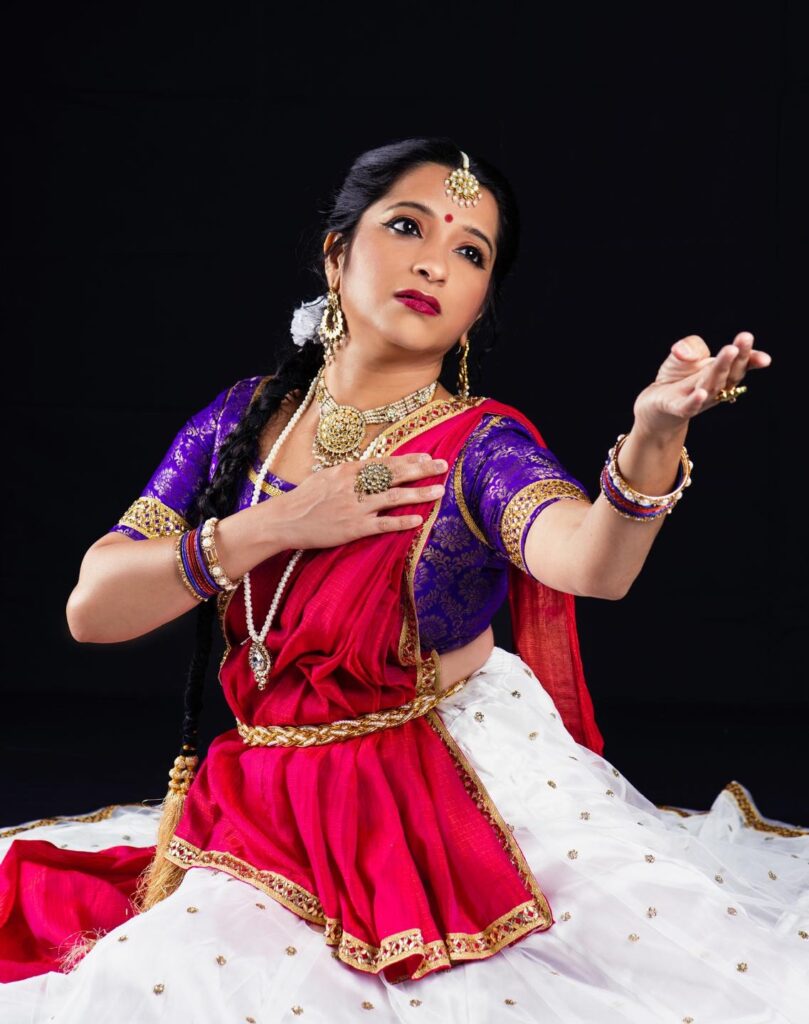
In an era where classical arts often bend toward spectacle, Guru Pallavi Degwekar’s approach stands apart. She honors tradition while embracing globalization, embodying what it truly means to be a Global Indian Artist:
“A Global Indian Artist is untethered to geography or genre, guided by a worldview that sees unity in all performance.”(The Global Indian Artist)
Her journey affirms a deeper truth:
“We do not step outside tradition by crossing borders; we reveal its deepest promise.”
(The Global Indian Artist)
Through the propagation and preservation of Kathak training on foreign land, she continues to uphold that promise. The work demonstrates that one does not need a perfect environment to sustain authenticity. Even in spaces where Indian classical art is not widely understood or immediately appreciated, devotion and discipline create continuity.
In a rapidly changing world shaped by technology and constant reinvention, a quiet question remains: What does it mean to carry tradition forward without compromising its depth?
A Dream Her Students Now Carry
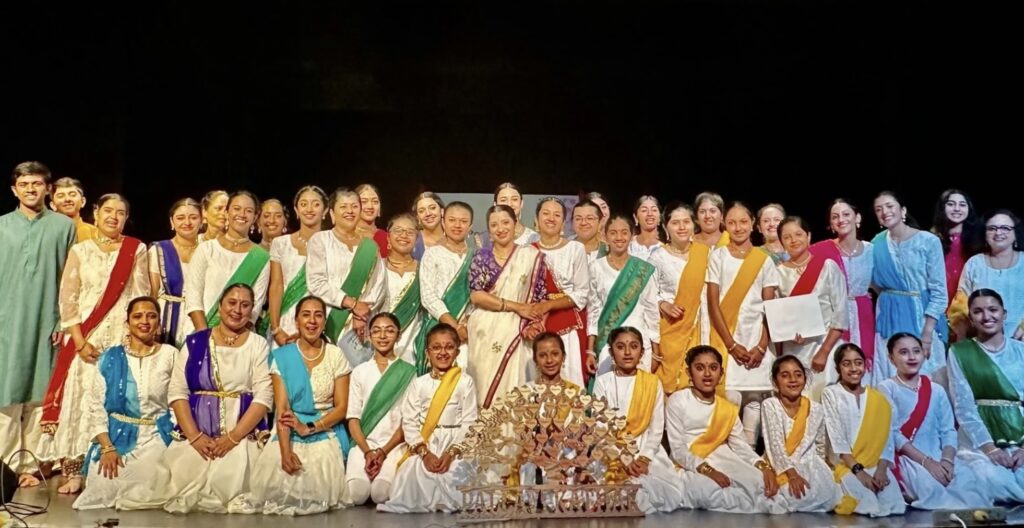
It is often said that we can never fully repay those who change our lives. As her students, we carry that awareness with gratitude. For years, she has created an environment where students can learn, grow, and find a sense of belonging, sustaining it without complaint and rarely revealing the effort required to keep it alive. As we grow older and begin to understand the depth of that labor, we recognize her resilience and share a single wish: that the space she has created may one day take form as a physical home, a true Gurukul.
A space where future generations can walk in and immediately feel the warmth, the discipline, the joy, and the sense of belonging she has cultivated.
A place filled with rhythm and laughter.
A place where students can learn deeply and grow boldly.
A home worthy of her lineage and worthy of the community she has nurtured.
A place to belong.
Photo Credits
All photographs courtesy of Pallavi Kathak LLC (@pallavikathak).
Pallavi Kathak:
References
Haviland, William A., et al. Cultural Anthropology: The Human Challenge. 14th ed., Cengage Learning, 2016.
Vallabh, Anita. “Beyond Boundaries: What It Means to Be a Global Indian Artist.” Global Indian Artist™ LLC Newsletter, 14 October 2025.