
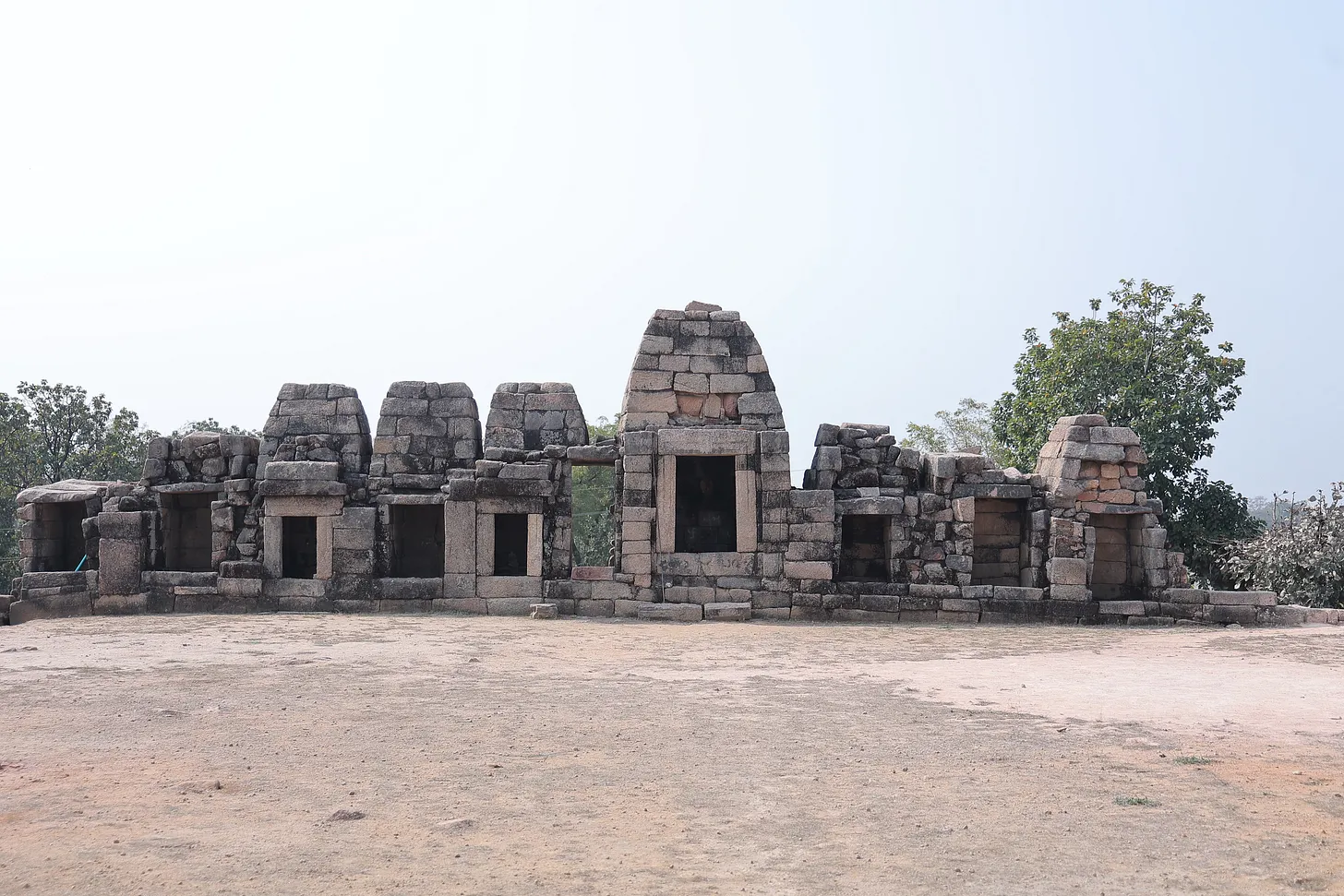
My mother and I set out the next morning with our guide Mr. Rajendra Verma, a history teacher at the local Angel Secondary school and photographer Mr. Neeraj Chaurasia. We set out walking along the lake Shiva Sagar toward the older temples. The morning sun was unforgiving, flattening shadow and sharpening stone. Our first stop was the Chausath Yogini Temple, among the earliest surviving shrines in the complex, dating to the 9th century.
Unlike the soaring sandstone temples of the Western Group, this shrine is circular, built of granite, and open to the sky. It once housed sixty-four Yoginis — fierce manifestations of the feminine divine associated with Tantric practice. There is no towering śikhara here, no sculptural abundance. Only enclosure and sky.
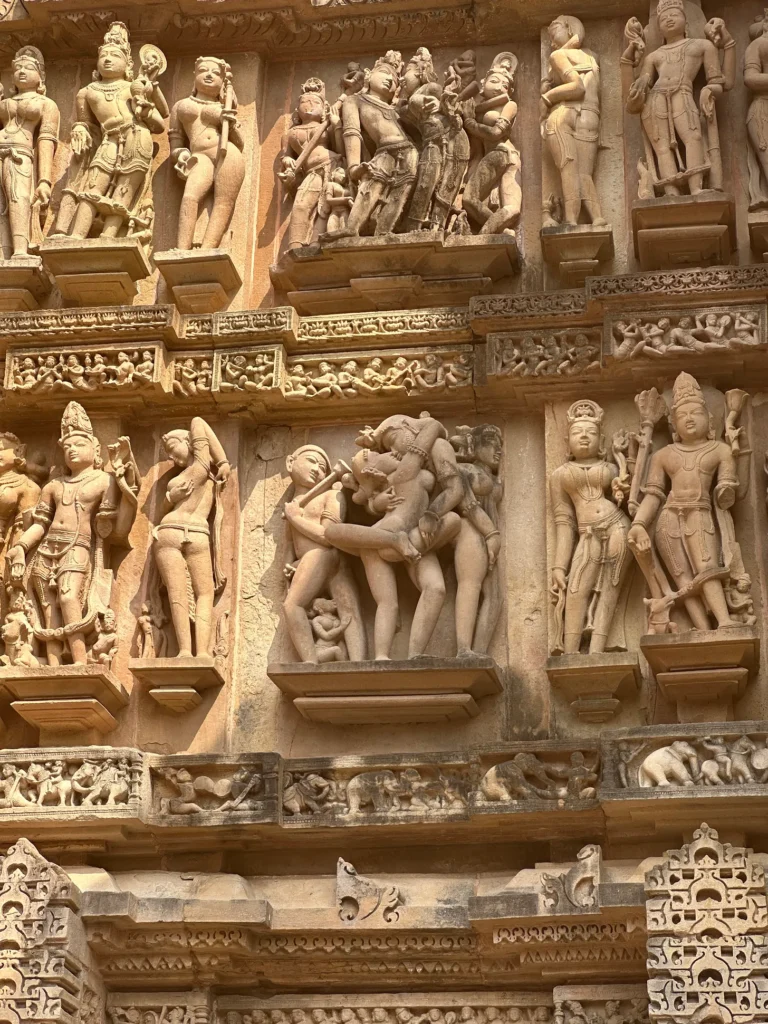
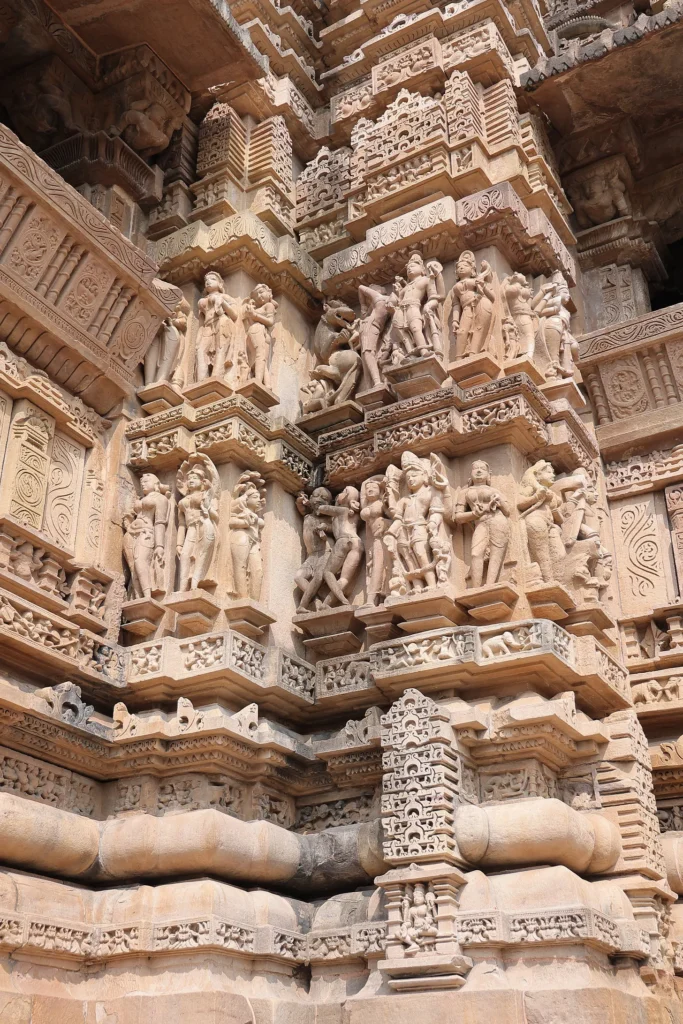
From there we moved toward the Western Group, built between the 10th and early 11th centuries under the Chandela rulers. The Kandariya Mahadeva Temple, completed around 1025–1050 CE, rises in clustered śikhara-s that gather toward a central spine. Facing it, one senses upward movement. The structure unfolds through successive mandapa-s toward the sanctum, while its exterior walls pulse in horizontal registers — musicians, dancers, warriors, lovers. The erotic imagery, so frequently foregrounded in popular imagination, is integrated within this wider visual narrative. Above these sculptural bands, the carvings grow increasingly abstract — repeating miniature spires and ascending motifs.
By evening, this stone landscape became the stage once more.
The opening Kathak performance by Vishavdeep of the Jaipur gharana felt entirely relevant in this Śaiva setting. His Rangila Shambhu Gowrare padharo pyara pavana welcomed Śiva and Pārvatī before moving into a tīntāl upaj, improvisation, within the sixteen-beat cycle. The dialogue between rhythm and Bol was measured. He concluded with Sunder Gori re, Nadaan Gori re,”weaving Rajasthani folk inflections into Kathak vocabulary. There was grace in his dancing — and the sense of an artist still growing into his authority.
The next presentation, Abhimanyu Vadh by Guru Prabhat Kumar Mahato in the Chau and Paika idiom, was marked by high energy and spatial precision. The Chakravyuha unfolded with clarity, the dancers moving in tightening concentric circles around Abhimanyu. Droṇācārya stood in white with a flowing beard; Abhimanyu, also in white, appeared valorous yet exposed; the remaining warriors — Karṇa, Kṛpācārya, Aśvatthāma, Śakuni, Duryodhana, and Duśāsana — encircled him in orange.
Rhythmic shifts distinguished Abhimanyu’s youthful intensity from the seasoned calculation of the elders. The moment he sought his teacher’s blessing and was refused marked a turning point. What followed was a young warrior confronting masters of war before attaining veer gati. Remarkably, even behind masks, the dancers articulated character with conviction — stance, tempo, and attack carrying emotion with striking power
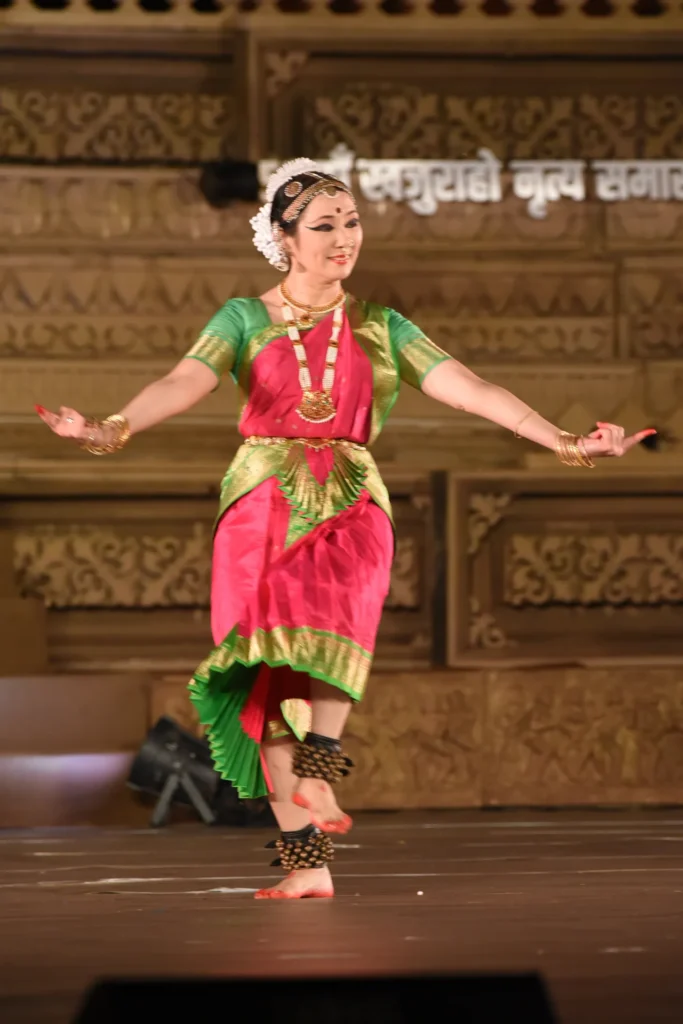
.The evening concluded with Bharatanatyam by Akmaral Kainazarova of Kazakhstan, trained at the Kalakshetra style. She began with an Alarippu in chaturasram — clean, centred, unembellished. The Muruga Sabdam expanded her expressive range, followed by an interpretation from Kumara Sambhavam, exploring the love of Śiva and Śakti through brisk jatis and controlled abhinaya. She concluded with a Nattabhairavi tillana.
There was sincerity in her performance, and visible joy — the kind that comes from devotion and immersion.When Indian classical dance is embodied by artists from other cultures, it reveals its ability to travel without losing its core. The vocabulary remains intact; the accent broadens.
By the end of Day Two, Khajuraho felt less like a site and more like a continuum — from Yogini austerity to Śaiva monumentality, from carved narrative to living gesture.