
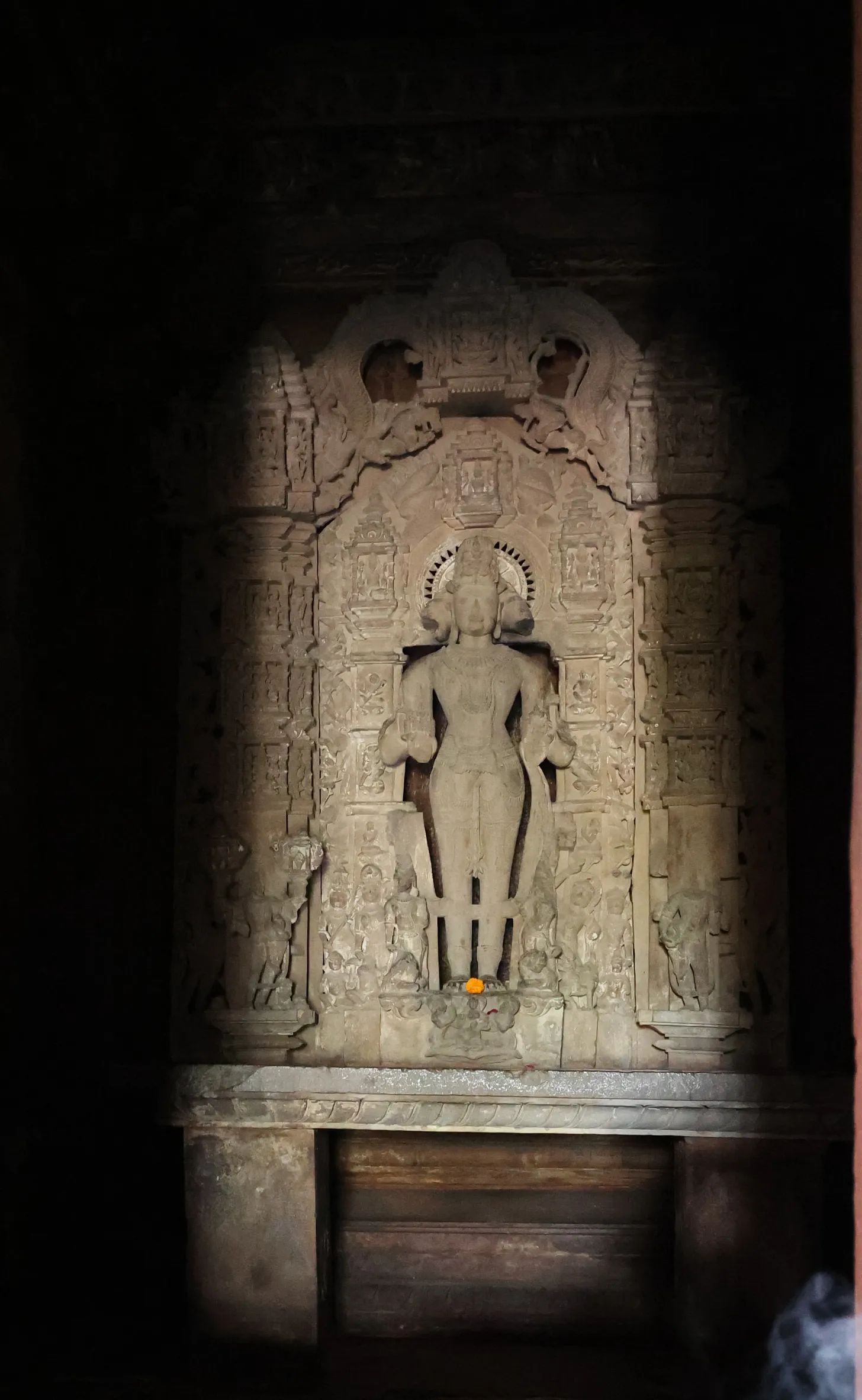
By the fourth day, the deeper layers of Khajuraho’s history — as both seat of power and site of devotion — became clearer. I found myself drawn to the Lakshmana Temple, one of the earliest and most refined temples of the Western Group, commissioned in the AD 10th century by the Chandela ruler Yashovarman (925-950), also known as Lakshman Dev Verman.
Here, the familiar “king–god” idea, so central to many South Indian temple traditions, finds a northern articulation. In what I can think of as a brilliant strategy, the Chandela ruler, in commissioning this temple, and the idol of Vishnu with four faces ( the fourth unseen to us) aligns himself with a deity who embodies not only divinity but vigilance and order. The central face is human, composed and assured. To one side emerges the lion aspect, recalling Narasimha — fierce, protective, unyielding. To the other appears the boar form, Varaha — the cosmic rescuer who lifts the earth from chaos. In a single body, preservation gathers its many expressions: calm authority, contained ferocity, decisive intervention. Just as Vishnu holds multiple aspects within one body, the king must hold strength, restraint, and responsibility together. Preservation of land, of people, of dharma becomes both divine mandate and royal obligation.
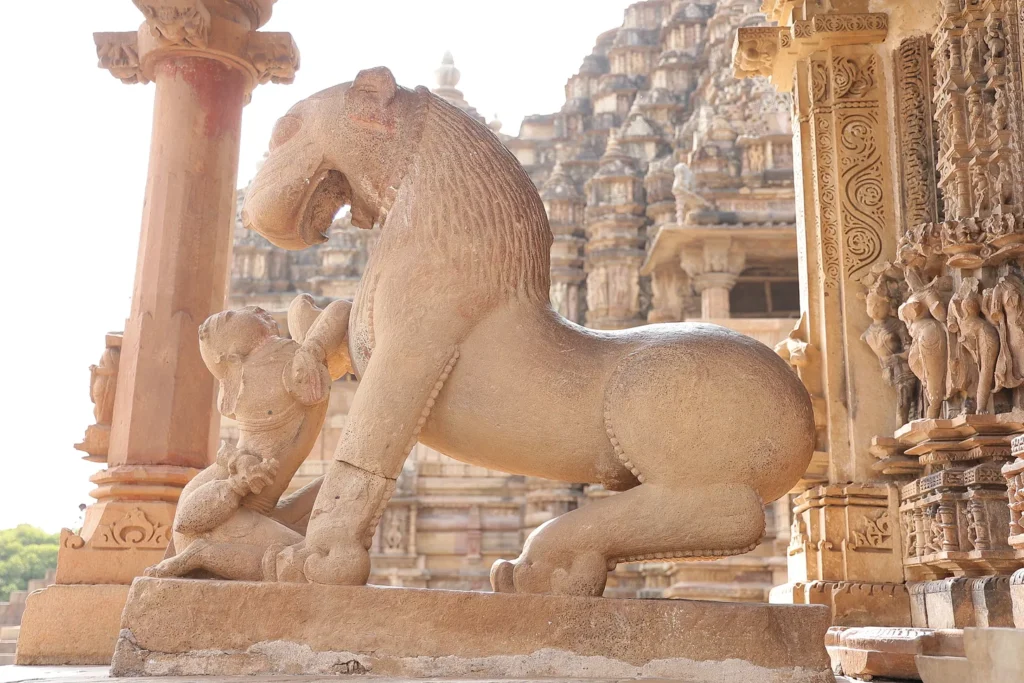
As we walk across the temple base, we encountered a striking motif: a human figure grappling with a rearing lion. The image appears repeatedly in Chandela architecture in front of the temples and is the central motif in the Mahadev temple as well. Local legend speaks of a Chandela prince Chandra Dev Verman ( Nannuk Dev Verman) who killed a lion, in an act that affirmed his right to rule. Whether historical memory or symbolic metaphor, the message is that sovereignty must be tested before the power to govern is bestowed.
The overarch theme of the temple concept resonates with : The king commissions the temple. The deity legitimizes the king. The temple becomes a conduit between earthly authority and cosmic order. This is the “king–god” concept made visible — rule aligned with dharma, sovereignty sanctioned through devotion.
By Day Four, the comparison between temple and dance felt natural. The myth of the temples and the content of dance sustain them and as the temple architecture rises like a spine — strong and ordered. The dancers, disciplined within their respective traditions, move, turn, leap, and bow within that architecture of meaning.
Returning in the evening for the performances, I began to see the three temples that frame the festival differently. Śiva rises in disciplined verticality. Devī embodies generative force. Viṣṇu preserves and stabilizes. Together they articulate a worldview in which power is aligned with divinity, tested, and sustained across generations.
The evening’s performances unfolded within this extraordinary setting.
Divya Nair opened the program with a Bharatanāṭyam recital. While technically competent, the curation did not fully engage with the grandeur of the venue. Khajuraho, with its associations of kingship, ritual, philosophy, and its powerful evocations of Śiva, Pārvatī, and Sūrya within sacred architecture, invites repertoire that resonates with such themes. Instead, pieces such as the jāvali Samayamu Idera felt more suited to the intimacy of a proscenium stage than to this monumental setting.
The evening then shifted in tone with the Kathakali presentation of Subhadra Haraṇam by Kottakkal Nandakumaran Nair, with Athira Nandan performing Krishna while Nandakumaran Nair essayed Balarama. Accompanied by the powerful rhythms of the chenda and maddalam, along with the metallic resonance of the chengila and ilathalam, the performance brought the dramatic intensity of Kathakali to the Khajuraho stage. Although the distance between the audience and performers made the subtleties of eye and facial expression difficult to discern, the theatrical power of the form remained unmistakable.
The final presentation of the evening was a Kuchipudi recital by Padmaja Reddy and her disciples, opening with Śrī Vighnarājam Bhaje. The dancers appeared in costumes representing different forms of the Goddess. However, since the recital was not structured as a thematic exploration of the Navadurga, this visual choice felt somewhat excessive. Across the performance, neither the choreography nor the musical composition rose to the evocative possibilities inherent in the Kuchipudi tradition.
Soon after the second piece we made our way back to The Scala, where warm food and a quiet room awaited us. Another day had unfolded in Khajuraho filled with the visual splendor of sculpted temples, the resonance of music and dance, and the gradual revelation of a civilization where power, devotion, and art once moved in profound alignment.
All photographs by Neeraj Chaurasia for Global Indian Artist (GIA).