
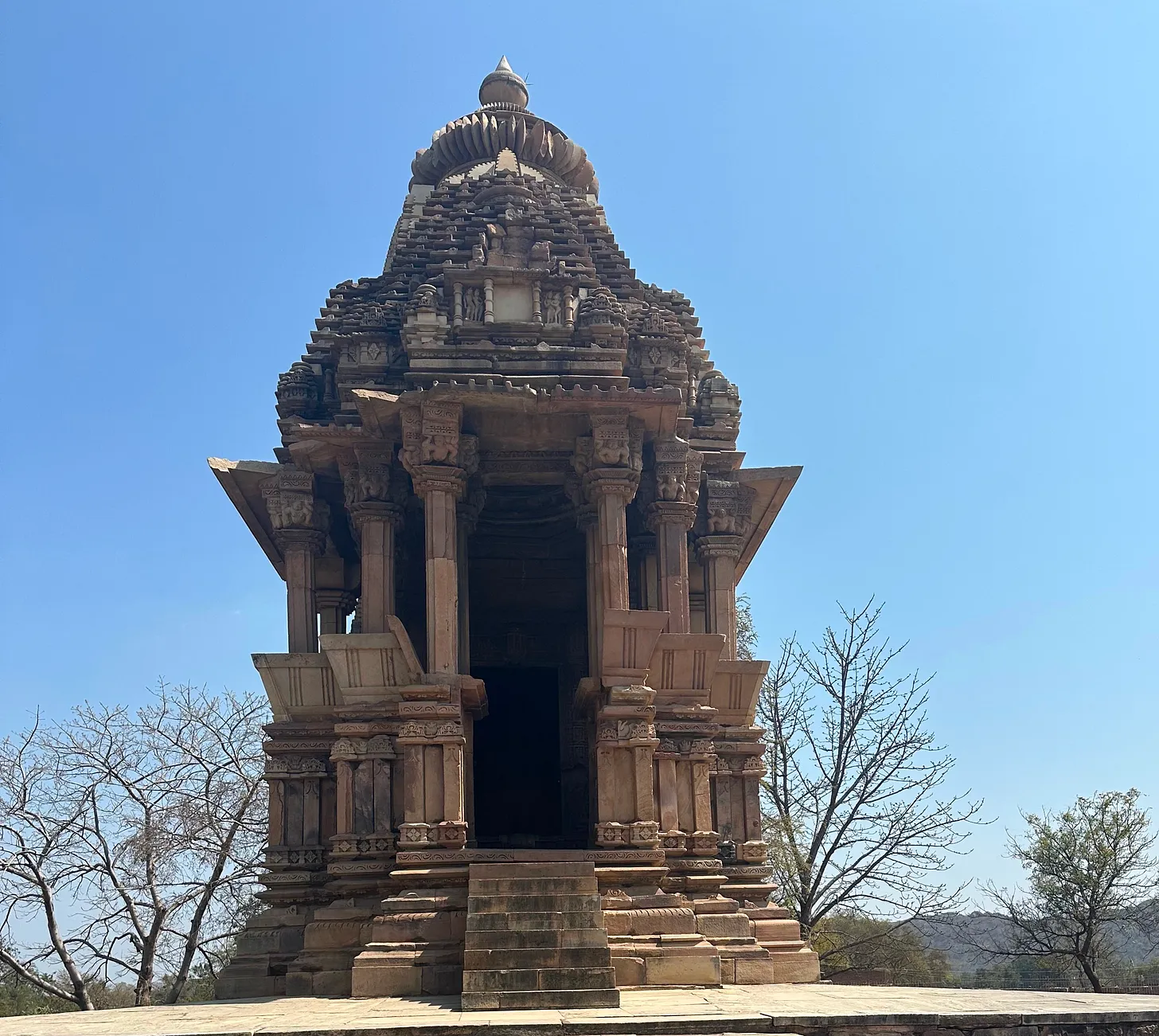
The following morning, we made our way to the Chaturbhuja Temple in the Southern group of temples, dedicated to Lord Vishnu. Standing somewhat apart from the more frequently visited Western complex, the temple has a quiet, solitary presence in the landscape
Unlike many of the temples at Khajuraho, the Chaturbhuja Temple contains no erotic sculptures and lacks the dense sculptural ornamentation characteristic of the Western group. Instead, its architectural program is restrained, drawing attention to the imposing nine-foot-tall image of Vishnu that dominates the sanctum.
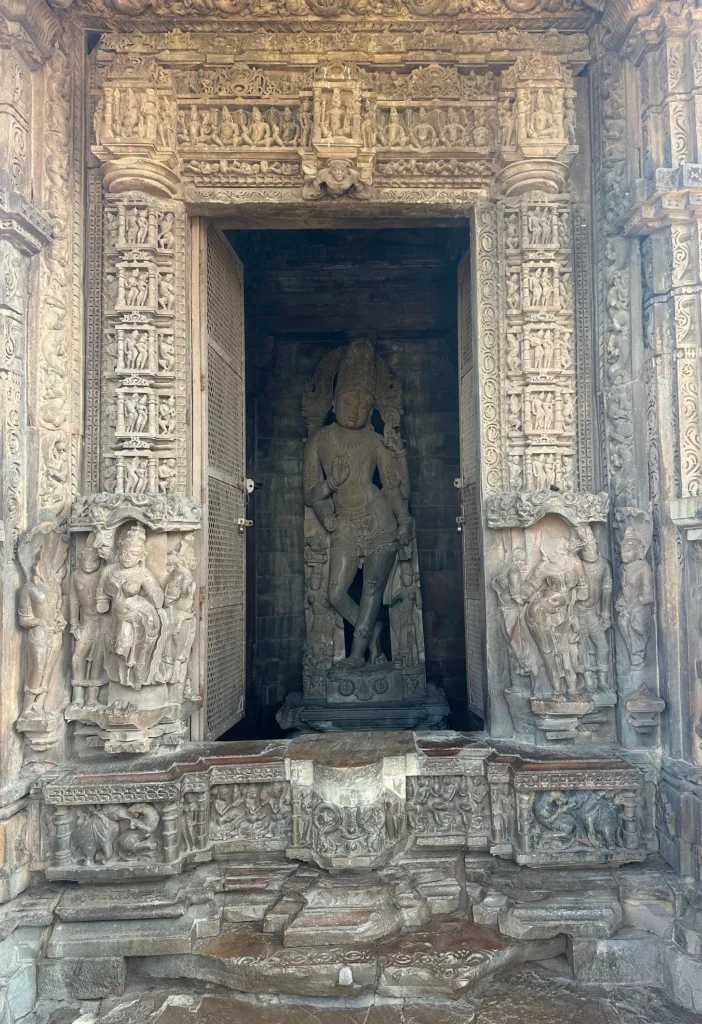
Another distinctive feature is the temple’s internal layout. There is no circumambulatory passage around the sanctum, nor the elaborate sequence of architectural spaces—antarāla and maṇḍapa—that one encounters in the grander temples of the earlier Chandela period. The relative simplicity of the structure is often interpreted by historians as reflecting the gradual decline of Chandela political power and, with it, the scale of royal patronage that had once supported the extraordinary artistic flourishing of Khajuraho.
In the evening, the program opened with Saswati Sen’s Kathak performance. She began with a Śiva ārādhana – Bho Śambho, venerating Śiva–Naṭarāja placed at the centre of the stage. She then moved into the celebrated composition Niratata Shankar Parvati Sang, choreographed by her guru Pandit Birju Maharaj.
What followed was a series of rhythmic explorations—tehāī patterns and layakari articulated through intricate footwork. Interwoven into these passages were evocative motifs of an Abhisārikā Nāyikā, along with moments drawn from everyday experience. Watching her perform it was a reminder that age often deepens the beauty and assurance of an artist’s expression.
The next performance featured Odissi dancer Sushree Mohanty, who began with Surya Ashtakam. However, the balanced execution required for the form—the sustained chauka (deep square stance) and the flowing tribhaṅga (triple bend)—along with the expressive depth that characterizes Odissi, did not quite come through with the clarity one hopes for.
The group presentation by Noyonsakhi Devi, an eminent Manipuri dancer followed. Opening with an invocatory Shantakaram Bhujagashayanam evoking the imagery of Vishnu in his many manifestations before moving into Aaja Hori set to Rudra Tāla, depicting the gopīs celebrating Holi with Krishna. With eight female and two male dancers, the stage was filled with graceful patterns and vibrant movement.
Watching the performances unfold was also a reminder of the distinct identities of India’s classical dance traditions—each with its own movement vocabulary, rhythmic sensibility, and aesthetic imagination.
As I noted in my journal: Khajuraho does not overwhelm merely because of its erotic imagery or depictions of everyday life. It overwhelms because of the many ways it continues to speak—of devotion, sovereignty, artistic imagination, and the enduring dialogue between the human and the divine.
All photographs by the author. Courtesy Global Indian Artist (GIA).
Khajuraho Chronicles Series