
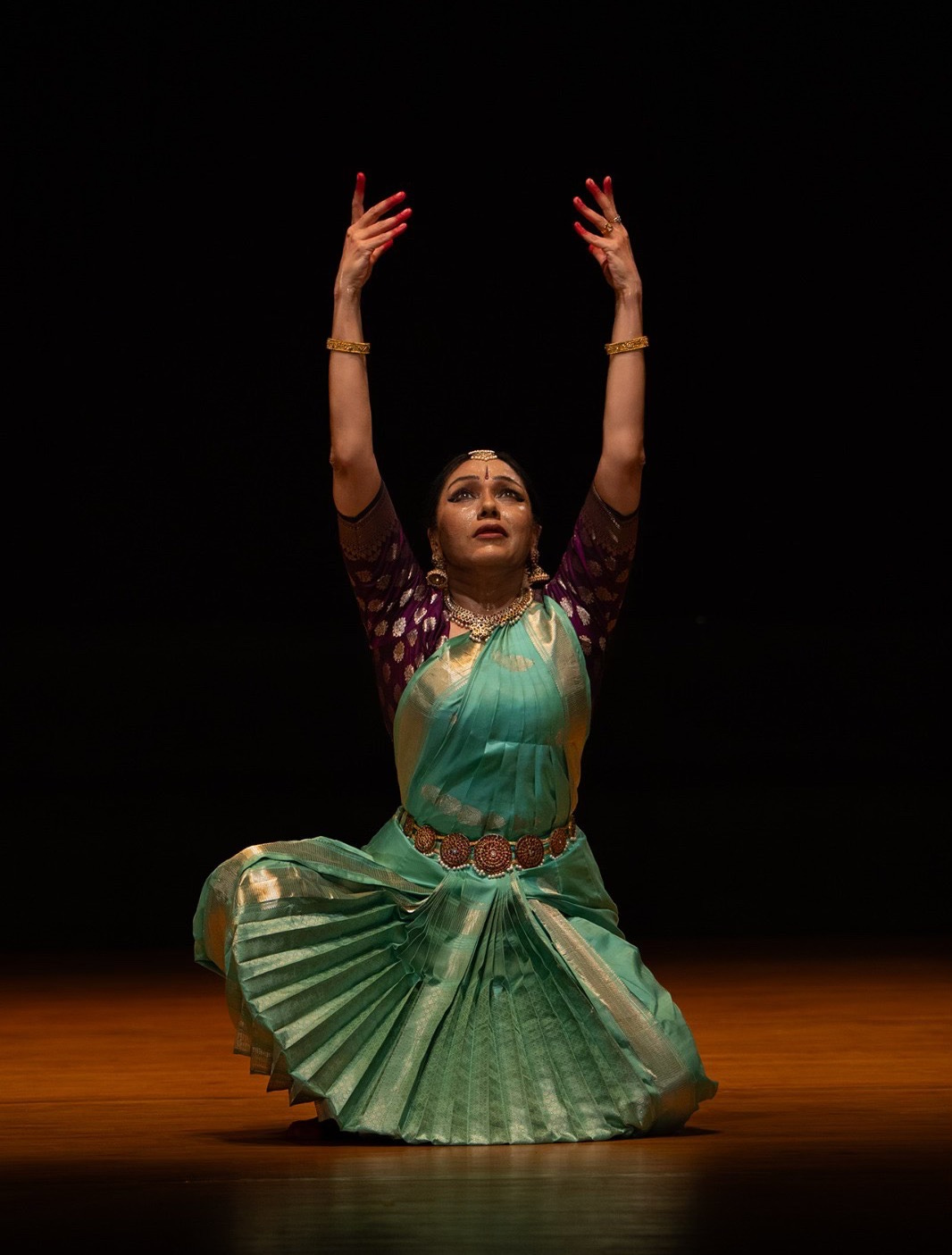
19th Annual Dance Festival, The Music Academy
January 3, 2026, Chennai
What distinguishes Rama Vaidyanathan’s performances is her rigorous curatorial intelligence, evident in choices that extend narrative, text, and imagination within Bharatanāṭyam. Her approach probes the emotional and philosophical essence of classical literary sources, articulating them through a contemporary sensibility.
The recital opened with a Śabdam by Thanjavur Arunachalam Pillai, aptly chosen for Arudra Darśanam. The heroine’s longing for the Lord was rendered with restraint and poignancy. An unexpected interpretive gesture appears when the bells “rain” from the sky as Śiva dances; the heroine gathers them and holds them to her heart—a simple yet enduring image of devotion shaped by imagination in the absence of physical presence.
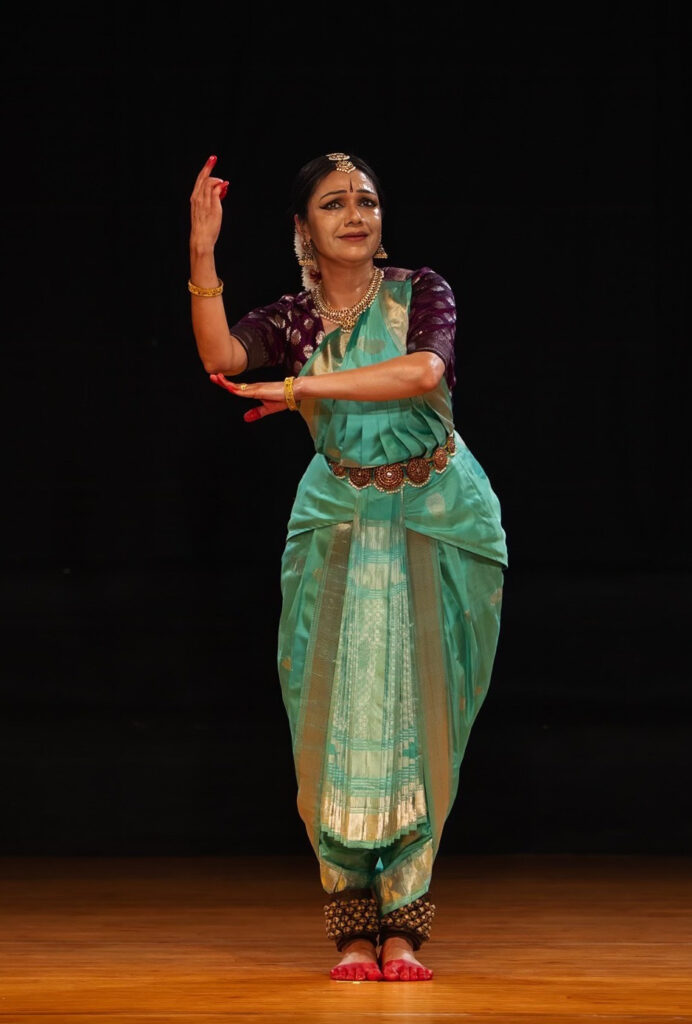
This sensitivity to visual metaphor deepened in the Tōḍi Varnam composed by Sri. M. Balamuralikrishna. After each jati, the dancer—as devotee—picks up a bangle, flower, anklet, and earring. These objects register the Goddess’s presence, yet She remains unseen. The implicit question—Where is She?—is resolved in the charaṇa svara, where the Devi is revealed as absorbed in dance and sound, seated among her musicians, unaware that she has dropped the very ornaments the devotee discovers. The affectively resonant singing of Vishwesh Swaminadhan, ably supported by S. Vasudevan (nattuvangam), Sumod Sreedharan (mṛdaṅgam), and Raghavendra Prasath (violin), functions here as a narrative witness, anchoring the Devi’s trance-like immersion. This circularity of motifs contributes to the recital’s structural coherence in subtle and intelligent ways.
The concluding piece drew from Ṛtusaṃhāra by Kalidasa, evoking vipralambha śṛṅgāra. The lone traveler embraces a mango tree, imagining it as his beloved, while she suffers elsewhere, wounded by mango leaves. Surya Rao’s lighting design proved especially effective, using focused spotlights to evoke the branching form of the tree while isolating the absent beloved, thus articulating separation through a shared visual vocabulary. The mango tree emerges as a symbol of nature as witness and emotional conduit.
Through such carefully layered choices, Rama Vaidyanathan demonstrates how classical material can be reimagined without dilution, retaining textual integrity while opening new interpretive pathways.
A fitting opening for a dance festival of stature.