
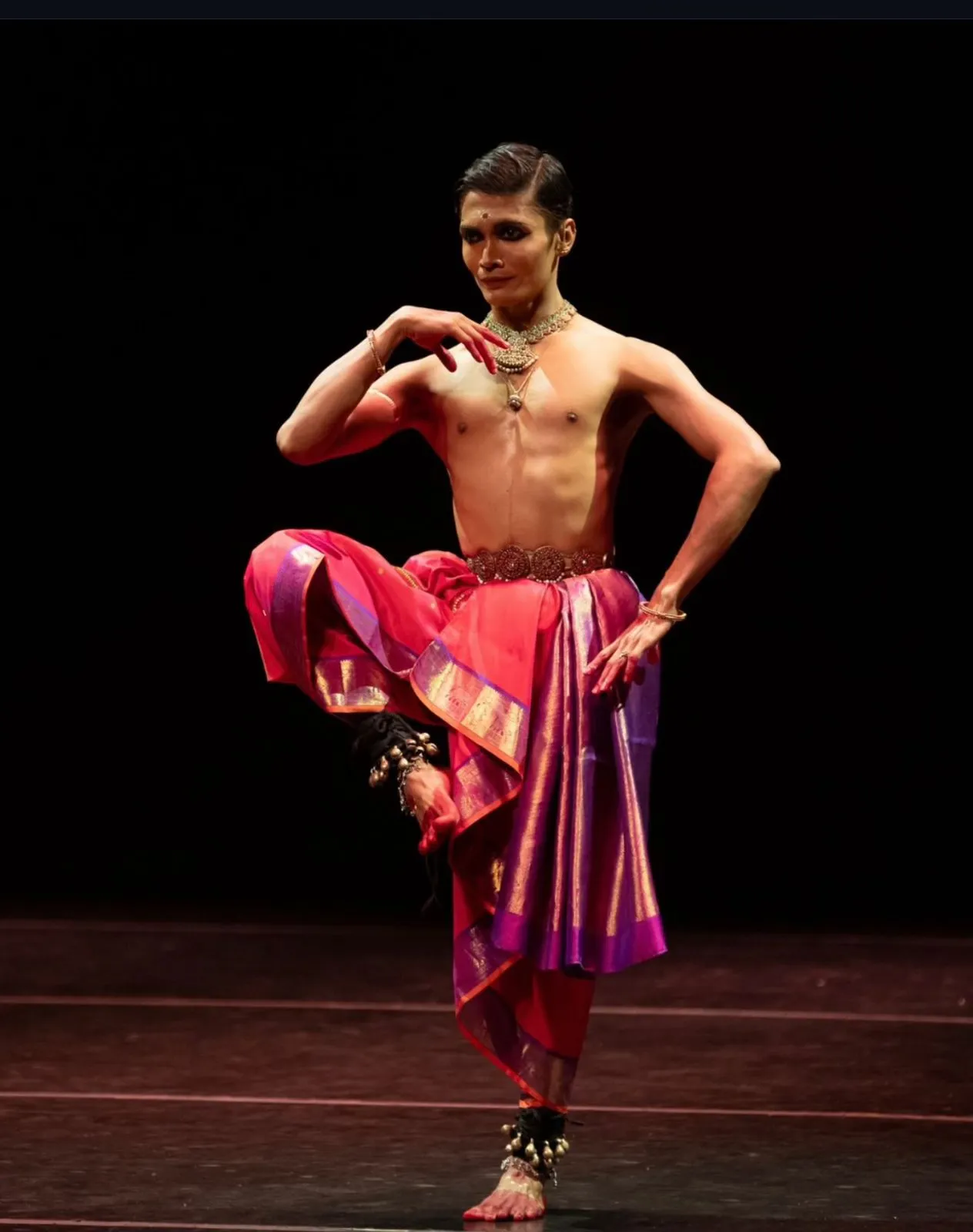
19th Dance Festival, The Music Academy, Chennai, 2026
Pritam Das presented a thoughtfully curated program of three pieces at the 19th Dance Festival. While each work reflected his evolving artistry, it was the varṇam—the pièce de résistance of the evening—that revealed the full measure of his imaginative and performative depth.
Artists, when curating performances, often take into account the preferences of host institutions and audience expectations. Some, however, follow their artistic instinct, seeing each performance as an opportunity for self-expression. This choice is not born out of disregard, but from an inner calling that values sincerity over conformity.
Pritam Das belongs to the latter. Of the three pieces he presented that evening, it is the varṇam—the most evocative work of the program—that is reviewed here.
His varṇam, a composition of Tanjavur Shivanandam, built on careful research and conceptual clarity, centered on the figure of a courtesan—a “sword-wife,” a ritualized role in which a king symbolically marries a courtesan through the act of the sword, housing her within the palace. In Pritam’s interpretation, one particular evening becomes the dramatic fulcrum: the courtesan attempts to woo the king, drawing him into an intimate exchange shaped by desire, power, and restraint.
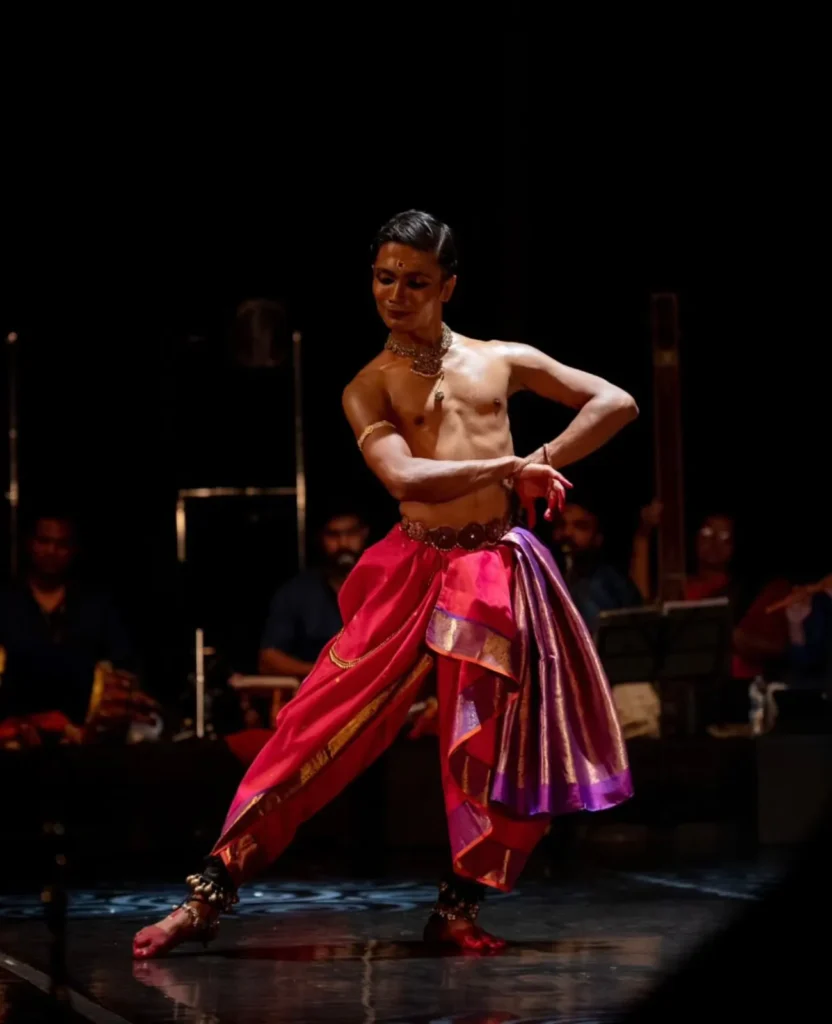
From the moment he entered the stage, Pritam became the courtesan. His sthāyi remained unwavering through the jatis, each sequence choreographed with deliberate intention toward seduction. The consistency of character, sustained across rhythmic passages, performed with lightness, grace, and speed while executing a range of combinations of pāda bhedas such as agratala sancara, kuñcita, and añcita, spoke to a performer deeply invested in internal coherence.
The most compelling moment arrived in the anupallavi, when Pritam crossed the stage diagonally as King Shivaji Maharajendra. The transformation—from courtesan to king—was striking in its clarity. A decisive shift in body language, gait, and gestural authority marked the transition.
Such immersion stems from a deep understanding of text and context, grounded in thoughtfully anchored artistic inquiry. The historical research, contextual grounding, and layered interpretation of the varṇam were shaped by Sri. Jeetendra Krishna, with scholarly inputs from Sri. Narayanaswamy Sankagiri.
The musical accompanists provided outstanding support, comprising Sri. Bijeesh Krishna on vocals, Sri. RLV Hemanth Lakshman on nattuvangam, Sri. Kalamandalam Charu Dutt on the mridangam, Sri. K. R. Shivaramakrishna on the mañjira, Sri. Hariprasad Subramanian on the flute, and Sri. Shyam Kalyan on the violin. The lighting design, enhancing mood and spatial definition was by Sri. Venkatesh.
Pritam Das has evolved steadily over the years. If he continues with this level of dedication and artistic honesty—curating works that allow research, imagination, and range to converge—the varṇam may well stand as a defining marker of a dancer very much on the rise.
The only minor discord in an otherwise compelling performance came during his rendition of the Tēvāram following the Tillāna. Positioned facing the idol on stage, with his back turned to the audience, his movements couldn’t be seen. While the gesture may have been intended as an act of devotion, its theatrical necessity remained unclear. In the larger arc of the evening, however, this moment did not overshadow the commitment, and expressive range that mark Pritam Das as a dancer to watch.